
Q3 2026 Investment Market Update
Investment portfolios declined marginally over the third quarter of 2026, as a confluence of factors weighed on risk assets over the period.
Performance was highly dispersed, with asset classes, and even sectors within the same asset class, behaving very differently. Results were also mixed month to month: July and September delivered negative returns, while August provided some positive contribution. For the quarter as a whole, returns ranged between -1.3% and -0.4%, depending on strategy.
During the quarter, the Investment Committee made a couple of portfolio adjustments, rebalancing some positions following end-of-financial-year distributions and increasing our exposure to listed real estate. By quarter-end, portfolios continued to hold a measured underweight to equities, maintaining a deliberate tilt toward investments offering more stable and predictable total return profiles. This positioning reflects our disciplined and risk-aware approach, managing valuation risks in an environment of elevated asset prices and continued geopolitical uncertainty.
We also launched a new investment solution during the quarter, the Arrow Accelerated Growth allocation. The allocation is designed for investors focused on wealth creation and accumulation, who may have a higher risk tolerance and capacity than those suited to the Arrow Diversified High Growth Portfolio, which is geared more toward clients who have already established their wealth. The key difference between the two is the level of targeted equity exposure, which sits higher than any of our current solutions. We’ve also built this model with superannuation monies in mind, aiming to outperform industry super fund high growth options while maintaining similar risk characteristics. The investment approach is deliberately simpler than our existing managed accounts, leaning on passive investment options and letting the long-term compounding of equities do the bulk of the heavy lifting. We’ve commenced work with platforms to formalise the strategy into a managed account structure, and if you’d like to find out more, please get in touch with either myself or your adviser.
International Equities
International equities were positive over the quarter, returning 1.3%. Our allocation returned -0.4%, below the benchmark. Our core active managers outperformed and added value, but this was offset by our emerging markets and small and mid-cap exposures, both of which lagged the broader benchmark.
The dynamic across international equities, and US equities in particular, has been unusual this year. The market has advanced substantially, yet it has become cheaper over the calendar year. Earnings growth from US corporates has been remarkably strong, and short-term expectations remain solid, suggesting these higher rates of growth may persist for at least the next twelve months. Earnings have simply grown faster than share prices, which has made the market cheaper on a valuation basis.
History suggests markets tend to get exuberant while the sun is shining and corporates are reaping the rewards, often overshooting on both earnings expectations and valuations. That hasn’t happened this time. I don’t claim to have all the answers, and perhaps once it’s all said and done, we’ll be able to piece the causes together with more clarity, but I’ll use this opportunity to explain what I believe has been driving it.
Sentiment: Despite the remarkable performance of corporates and the US economy more broadly, the feeling on the street is very different. Investors remain fairly cautious, and consumers are arguably even more so. The person on the street is dealing with a confluence of issues, including rising cost of living pressures, higher mortgage rates and job insecurity driven by fears of AI replacing roles. These pressures fall hardest on low and middle-income households, which aren’t the loudest voices in markets but make up the largest part of our society. I believe this shift in sentiment and heightened uncertainty has pushed people to become more conservative in both their outlook and their planning.
Reservations around AI: Artificial intelligence (or super intelligence...) remains a massive uncertainty for everyone. The AI ecosystem, and the infrastructure rollout and spending that comes with it, has driven the bulk of this earnings growth. Possibly the biggest question in markets right now is whether this capital expenditure will convert into profits in the years ahead. Investors remain highly sceptical and wary of an earnings bubble, so much so that I’d go as far as saying being bullish on AI is now a contrarian view, with most investors expecting some form of bust. Simply staying invested and holding the market, given its current composition, could prove a highly rewarding trade should the show go on.
Heightened political and geopolitical uncertainty: The geopolitical environment has changed substantially over the past few years. We’ve seen a raft of conflicts break out globally, most notably between Russia and Ukraine, but also US military action in both Venezuela and Iran this year. We have undeniably entered a riskier regime, and investors have responded by becoming more conservative, demanding higher risk premiums, or greater rewards, before deploying capital into risk assets such as equities.
Bond yields and alternative investments: Somewhat intertwined with the previous point, there has been a large sell-off in bonds globally, US Treasuries included. This is similar to the move that drove the 2022 equity bear market, but this time it’s starting from a higher base, and many investors have now learnt what duration is. It also creates a dilemma for anyone allocating fresh capital, as the return available from defensive and risk-free assets (should you believe the US Government won’t ever default on its debt) continues to improve. US high yield bonds, for example, now offer returns in line with the targets of many pension funds, meaning investors no longer need to reach as far up the risk spectrum to hit their return objectives, which in turn allows for a reduction in equity exposure. This has been consistent with our views and positioning for some time. Previously there were “no alternatives to equities” today there are.
The combination of these factors has resulted in valuations compressing substantially over the course of the year, with the forward P/E multiple falling from 23x to 19x today. That means equities are roughly 17% cheaper today despite the market delivering strong returns year to date. This flows through to the individual company level too, with names such as NVIDIA trading near their lowest valuation in more than a decade.
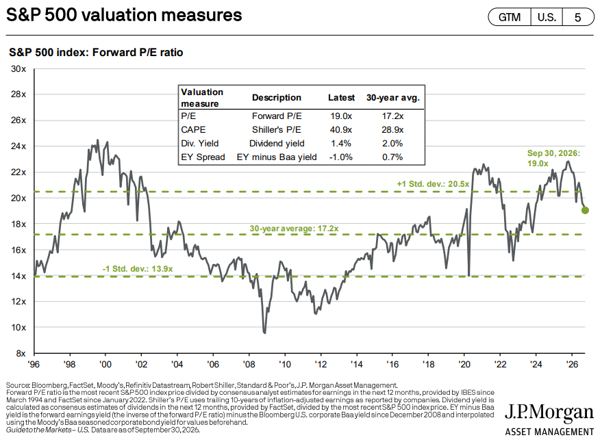
Source: JPMorgan
During the quarter, we made one change to the allocation, finalising the reallocation of our global small and mid-cap equities, which commenced earlier in the year and was completed in two tranches. I covered the rationale last quarter, but in short, we believe the case for dedicated small and mid-cap allocations has weakened structurally. As companies stay private for much longer, and at far greater scale than in the past, the businesses generating the most explosive growth today are often reaching valuations in the hundreds of billions before ever listing. The “early stage” opportunity that small-cap investing was designed to capture increasingly plays out in private markets rather than public ones. This exposure has also been a meaningful driver of tracking error within our global equity allocation, and its underperformance relative to benchmark has been an ongoing discussion point for the Investment Committee. We believe this change will help narrow that gap.
Australian Equities
In line with other markets, Australian equities edged higher over the quarter, returning 1.3%.
We continue to believe the outlook for the Australian market remains challenging. Many of the reasons will be familiar by now: elevated equity market valuations, cost of living pressures, poor consumer sentiment, rising cash rates, and you can now add a property downturn to the mix. That said, Australian equities won’t underperform forever, and they do offer meaningful diversification away from the AI trade should that trade deteriorate (although there are probably better ways to hedge that risk within a multi-asset portfolio).
I don’t want to keep labouring the point, but our local market’s underperformance has been substantial, both against our own portfolios and against global markets. Over the last year, international equities have outperformed Australian equities by 9%, and by even more on a currency-hedged basis. Our substantial underweight to Australian equities has served clients well. Our headline underweight to risk has been taken specifically from Australian equities, and the defensive allocation holding that capital has itself outperformed the local share market over the past 12 months. The result has been strong portfolio outcomes, particularly on a risk-adjusted basis.
One of the biggest stories in the Australian market over recent weeks was Firmus, though not for the reasons expected. The business designs, builds and operates specialised, energy-efficient data centres known as “AI Factories”, optimised for heavy artificial intelligence computing. Put simply: AI infrastructure. The float stood out for a couple of reasons. Firstly, the company sits within, or at least adjacent to, the technology sector, where our local market has very little representation. Secondly, there was its sheer size. At launch, the company’s market capitalisation was expected to be roughly $44 billion, which would have made it one of the largest IPOs in Australian history. That valuation fell rapidly as the offer struggled to get over the line with institutional investors, and the IPO has since been pulled altogether. In many ways, it’s a real-world example of the AI scepticism discussed in the international equities section, with investors unwilling to pay up for AI infrastructure despite the strength of the underlying theme.
While not a direct change to the allocation, it’s worth explaining what happens each July. Investments across the portfolio distribute income to investors, whether that’s one month’s, three months’, six months’ or a full year’s worth, depending on the asset class and investment. Australian equities, being one of the highest-yielding asset classes in the portfolio, generally pay a large distribution, which reduces the position size at the portfolio level as cash is paid out. This year, we elected not to rebalance back into Australian equities, and instead redirected that capital toward other opportunities across the portfolio.
Property & Infrastructure
Property and infrastructure allocations both sold off over the quarter. Listed infrastructure declined 5.8%, while Australian listed property fell 8.4%, though as noted in previous letters, this isn’t an asset class we explicitly allocate to.
It was a tough quarter for both, with substantial declines following a strong stretch over the prior twelve months. By their nature, these asset classes provide exposure to long, stable streams of cash flow, often contracted. As a result, the assets are valued on cash flows stretching many years into the future, rather than on near-term earnings momentum. This makes infrastructure and property particularly sensitive to changes in bond yields, which have been very volatile over the past 12 months, and the global bond sell-off discussed earlier weighed heavily on both over the quarter.
A similar dynamic is playing out in Australian residential property at the moment, though it’s harder to see in real time, as these assets aren’t listed on an exchange with daily mark-to-market valuations. A mix of cost-of-living pressures, housing unaffordability, rising interest rates and tax reform has put a dampener on the residential market, with values across the five largest capital cities sliding around 6% from their 2025/26 peak to the end of September. There’s little relief in sight either, with at least one further rate hike from the RBA expected over the balance of 2026. Some market participants suggest the current drawdown is approximately halfway finished.
During the quarter, we increased our allocation to global listed real estate, moving from an underweight to a less underweight position, funded from the Australian equity allocation. This decision was driven by very strong fundamentals and operating outcomes across listed property globally. The asset class remains one of the few attractively valued pockets of the market, underpinned by a supportive earnings outlook and limited new supply coming online as development costs continue to rise.
Private Equity & Venture Capital
Private equity strategies delivered a quieter quarter. Core buyout strategies returned between -1% and +5%, depending on the fund, while our venture strategy delivered +2.8%. It’s worth noting we’re still awaiting end-of-September valuations for a number of underlying strategies, so these figures will be revised once received.
The asset class has held its own over the past 12 months, contributing positively to portfolio returns through what has been a challenging environment for most asset classes.
We’re now a few months on from the SpaceX IPO, which was highly topical, divisive, and the largest ever IPO by market capitalisation. The chatter has since died down, and early investors are beginning to have their stock released from escrow. The stock has been well supported on market, trading in a range of US$104 to US$226, and sitting at US$168 at the time of writing, well above its IPO price of US$135 per share. All things considered, it can so far be regarded as a broadly successful result. That outcome will likely pave the way for a number of other high-profile IPOs, with Anthropic reportedly slated to go public before the end of the calendar year.
Last quarter, we flagged that redemption requests for the Partners Group Global Value Fund had exceeded 5% of the fund’s value, and that redemptions would therefore be paid on a reduced basis. The fund has been a longstanding position within our portfolios, one of the few investments held since inception, providing access to Partners Group’s platform of buyout private equity investments.
Gating is a feature built into the fund’s structure to protect existing investors, allowing liquidity to be managed carefully given that a large proportion of the underlying assets are illiquid and would otherwise need to be fire-sold to meet redemptions. The reduced liquidity does create frictional issues, both for portfolio management and for investors who need to fully wind down their position, such as in estate or family law matters.
In the meantime, we have taken several proactive measures. We are seeking liquidity wherever it’s available, and we have ceased all new investment into the fund with immediate effect. This quarter, we also appointed a replacement for the position, the KKR K-PRIME Fund, which pursues a similar strategy and draws on KKR’s broader investment platform. Any new investors, along with capital reinvested from income distributions, are now being allocated to KKR in place of Partners Group. Over time, this will gradually reduce the weight of the Partners Group position within portfolios.
Enhanced Income
Australian bonds returned -1.17% over the quarter, underperforming cash.
It was a horror quarter for bonds, with the asset class selling off and delivering negative returns. This part of the market underpins the valuation of many other asset classes, so steep and rapid moves here tend to cause volatility elsewhere, both immediately and over time as investor risk appetite resets. It’s often hard to point to any single driver, but I’d suggest two. The resurgence of inflation globally has put pressure on central banks, and on top of that, investors are facing greater uncertainty about tying up capital for long periods and are demanding a higher term premium before committing to an investment with a fixed return for 20 to 30 years.
The RBA began the period with the cash rate at 4.35%, having lifted it from 3.60% through hikes in February, March and May. In August, it held rates steady in a unanimous decision while it assessed how the earlier increases were flowing through the economy. That pause proved short-lived. Stronger than expected July inflation data brought forward a move that most economists hadn’t anticipated only a month earlier, and in September the RBA raised the cash rate by 25 basis points to 4.60%. It was another unanimous decision, the fourth hike of 2026, and took the cash rate to its highest level since November 2011.
Floating rate investments continue to benefit from a higher and rising interest rate environment, as their returns in many instances rise in step with rate hikes. The same can be said for cash and term deposits. This pocket of the portfolio continues to offer an attractive opportunity set for investors.
While not held directly within our managed account, one of the private credit managers we use in some client portfolios, Metrics Credit Partners, was in the press toward quarter-end. Metrics lends money to Australian companies and property projects, and the bulk of our clients’ exposure to the manager is via the Metrics Direct Income Fund. This quarter, the fund’s auditors took a more cautious view than Metrics on what a number of its loans may ultimately be worth. As a result, the fund’s value will be reduced by around 2%, and withdrawals will be paused for several weeks while the new figures are finalised and investor compensation is worked through. We know news like this is unsettling. It’s worth stressing that these reductions are estimates of value rather than realised losses, and the fund is expected to continue paying its monthly income throughout.
Private credit makes up a small part of our portfolios and is spread across several managers. We use it because it has paid a reliable income that rises with interest rates, and that has served clients well over time. Even after this quarter’s reduction, the fund has returned around 6% over the past year and around 8% per annum over three years, compared with 0.2% and 3.8% respectively for government bonds. We have met with Metrics’ senior team, paused any new investment with them while our review continues, and are working to continue to enhance this part of client portfolios. We’ll keep you updated as our review progresses.
Performance & Positioning
Portfolio performance drifted lower over the quarter, and one-year returns have dropped away substantially, as a negative quarter replaced a strong one in the rolling twelve-month window. For our growth portfolios, one-year returns have fallen from roughly 10% to between 4% and 6% in the space of three months. This can easily happen with short-term performance figures, and I liken it to a golf handicap (apologies to the non-golfers who have made it this far). When a good round drops off the back of your record and is replaced by a poor one, your handicap moves more than your actual game has. Longer-term returns over a three-year horizon remain very strong, in what has been a good stretch for investors – Again in line with prior memo’s we don’t anticipate double digit return outcomes will continue forever.
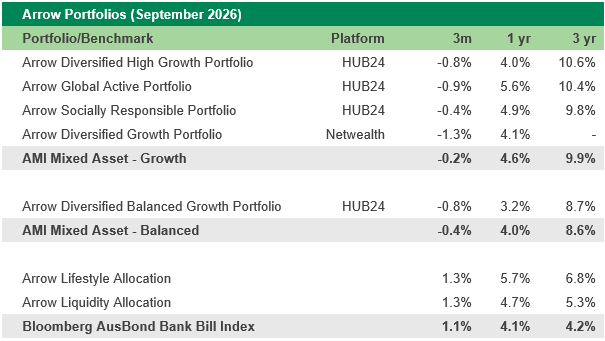
Portfolio performance over the quarter was softer than we would like, with our portfolios trailing the broader peer group. We can’t control the direction of markets, but we can influence our relative performance. The past twelve months have been challenging for our strategy, with the Arrow Diversified High Growth Portfolio, which holds the largest share of our assets under management, trailing its peer group by 0.6%. Underperformance is never pleasant to report, and we don’t wish to dress it up.
That said, any active approach will experience periods of both under and outperformance along the journey, and it’s the discipline to stay the course through the lean stretches that allows the longer-term benefits to be captured. Our approach has enjoyed a good run of outperformance since the end of 2022, and the three-year numbers remain solid, with the Arrow Diversified High Growth Portfolio sitting approximately 0.7% per annum ahead of its peer group. We view the recent period as a pause within that broader record rather than a change in its direction.
On the defensive side, our allocations targeting cash plus 1% and cash plus 2% over one and three-year horizons respectively continue to deliver stable, consistent returns. Despite some softer outcomes in recent months, I’m really pleased with what these allocations are delivering for clients. It’s worth contrasting them with the alternative, a fixed-rate portfolio of predominantly government debt, which locally would have delivered a return of 0.2% over the past 12 months. Interestingly, both allocations have outperformed our core growth portfolio, and the broader peer group, over the past 12 months. They’re delivering on their objective of providing reliability for clients with shorter investment horizons or lower risk appetites and continue to play an important stabilising the growth component of investors portfolio.
There’s a bit of change happening at the portfolio level at the moment. Partly, it’s to address some shorter-term underperformance, where the drivers are identifiable. Partly, because a few positions within the portfolio have become increasingly correlated over time, and finding solutions there should improve diversification and, hopefully, downside protection. One major positive for us and our clients is that the range of investment options available to us continues to broaden. As more solutions from high-quality institutional managers enter the universe, we can keep improving the portfolio and consider ideas that previously weren’t available. I view this as a substantial positive for clients.
Should you have any questions about anything covered in this letter, please don’t hesitate to get in touch. We’re always happy to discuss in greater detail.
Kind Regards,
Ryan Synnot
Head of Investment Management
Arrow Private Wealth
Similar Insights

Latest Insights

General Advice Warning:
Any general advice in this email does not take account of your personal objectives, financial situation and needs, and because of that, you should, before acting on the advice, consider the appropriateness of the advice, having regard to your objectives, financial situation and needs.