
Q2 2026 Investment Market Update
Investment portfolios recovered strongly over the second quarter of 2026, as conflict in the Middle East simmered and several markets marched on to fresh highs.
Performance was broad-based across asset classes, with the majority of portfolio holdings contributing positively to outcomes. Results were strong in each month of the quarter, with April, May and June all delivering solid gains for investors. For the quarter as a whole, returns ranged between 4.9% and 7.4%, depending on strategy.
During the quarter, the Investment Committee made a couple of portfolio adjustments, including unwinding some of our currency hedging and lightening exposure to global small and mid-cap companies. By quarter-end, portfolios continued to hold a measured underweight to risk assets (equities), maintaining a deliberate tilt toward investments offering more stable and predictable total return profiles. This positioning reflects our disciplined and risk-aware approach, managing valuation risks in an environment of elevated asset prices and continued geopolitical uncertainty.
International Equities
International equities rallied strongly over the quarter, returning 13.8% in Australian dollar terms. Our allocation returned 11.1%, below the benchmark, with the shortfall largely attributable to our value exposure and core active managers, both of which underperformed over the quarter.
International equities bounced hard in the June quarter as markets looked through the crisis in the middle east, growing confident that a resolution would avoid the kind of escalation that would seriously undermine the global economy. It was the strongest quarter for international equities since the initial stages of the pandemic in 2020.
US equities remained the major driver of returns, continuing to benefit from strong earnings growth and extraordinary AI-related capital expenditure. However, valuations became more demanding, and market breadth was once again an issue. In recent months, investors have increasingly focused on whether AI investment will translate into durable productivity gains and cash flows, or whether parts of the market are beginning to price in an overly optimistic adoption path.
Year to date, the market has really diverged into two outcomes: AI beneficiaries, and the rest. The chart below, from LifeCycle, highlights the dispersion in returns across companies in the benchmark year to date to the end of May, ranked from worst to best performer, with notable AI beneficiaries flagged. The majority of the best-performing companies this year have been some form of beneficiary of the AI cycle, and these aren't always the traditional tech names you'd expect. Caterpillar, for example, primarily known for construction equipment, has seen exponential demand for its power generators used to help fuel data centres. The story repeats itself across plenty of unexpected corners of the market.
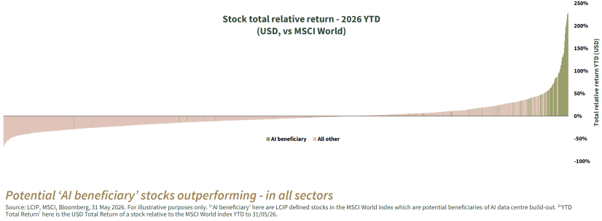
The top-performing companies year to date have actually been in the memory space. Despite a recent correction, top-tier memory companies have still vastly outperformed the broader market this year on the back of insatiable AI demand and tight supply, with names like Micron and SanDisk among the standouts.
That trend waivered in June, as US small caps and stocks outside the tech sector started to outperform. Should this continue to unfold, it would be supportive for our positioning, which offers more diversified exposure than a headline market-cap-weighted benchmark.
During the quarter, the Investment Committee made two changes within the global equity allocation.
Firstly, we reduced the level of currency hedging across the portfolio. The Australian dollar has appreciated significantly against the US dollar over the past year, moving from a discount to at or above most estimates of long-term purchasing parity. With much of that re-rating now likely behind us, we took the opportunity to lock in the benefit and reduce our hedging level, bringing it back toward the portfolio's long-term neutral setting. This is expected to lower ongoing hedging costs, improve after-fee returns on offshore holdings, and add a bit more defensiveness to the portfolio overall, since unhedged currency exposure tends to act as a buffer when global markets sell off.
The second change was more structural and longer-term. We believe the case for dedicated small and mid-cap allocations has weakened structurally. As companies stay private for much longer, and at far greater scale than in the past, the businesses generating the most explosive growth today are often reaching valuations in the hundreds of billions before ever listing. That means the "early stage" opportunity small-cap investing was designed to capture increasingly plays out in private markets, not public ones. At the same time, this exposure has been a meaningful driver of tracking error against the benchmark within our global equity allocation, and the underperformance of that allocation relative to benchmark has been an ongoing discussion point for the Investment Committee. We believe this change will also help narrow that gap.
Australian Equities
In line with other markets, Australian equities rallied 4.1% over the quarter and generated good outcomes for investors. The recovery was more subdued in our local market, with the benchmark still yet to reclaim its March high. Our Australian equity allocation also returned 4.1% over the quarter.
Australia notably lagged global peers, returning just 6.1% for the financial year. The local market had less exposure to the technology and AI themes driving global indices, while earnings growth remained more subdued. Banks and consumer-facing sectors were pressured by higher funding costs, stretched household balance sheets, and concerns around the housing sector. Resources provided some offset as commodity prices rallied, but this wasn't enough to close the performance gap with the US and technology-heavy Asian markets.
The budget was ultimately the biggest talking point of the quarter, and there's no shortage of commentary out there already, so I won't try to compete on that front. Instead, I'll offer a couple of observations from an investment perspective.
The first relates to how we think about after-tax returns. Under the prior CGT regime, investors were much more willing to take their return in the form of capital appreciation, since holding an asset for more than 12 months effectively halved your tax rate on the gain. With that discount removed, capital gains are now treated more harshly, and investors will naturally become more indifferent to how a return is generated, whether via income or growth, than they were previously.
The second is portfolio turnover. We never turn over a portfolio for the sake of it, but even in a fantasy world where every decision was correct, some turnover would still be necessary, as higher-risk positions outperform lower-risk ones and need to be rebalanced back to target weights. We don't operate in a fantasy world, so there's an inherent level of turnover beyond that: ideas that work get closed out and reallocated, ideas that don't work (we're not perfect) also get closed out, and positions become dated or less competitive relative to newer strategies. Given the changes to CGT, portfolio turnover will now come under closer scrutiny, and will have a larger impact on portfolios, since the discount will no longer apply and the frictional cost of turnover is now higher on an after-tax basis.
Without wanting to labour the point on our local market, the degree of underperformance over the past 12 months, relative to both our own portfolio and global markets, has been substantial. Over the last year, international equities outperformed Australian equities by 11.3%, and by even more on a currency-hedged basis. Our portfolio positioning has navigated this well, with a substantial underweight to the Australian equity allocation. While we've been positioned underweight risk at the headline level, that underweight has come specifically from Australian equities, and we've generated healthy returns via our defensive allocation, which has itself outperformed the local equity market over the past 12 months. This has translated into strong portfolio outcomes, particularly on a risk-adjusted basis.
While not strictly an Australian Equities matter, it's worth flagging here that we received some disappointing news toward the end of the quarter: an underlying portfolio position, the Perennial Natural Strategic Resources Fund, announced that it had hit capacity and is no longer accepting applications. A victim of its own success, having been one of the portfolio's top performers in recent years, returning 109% on a cumulative basis since its inclusion in December 2023. Capacity has been constrained deliberately, to preserve the nimbleness the portfolio management team needs to turn over and reposition the fund as required. For now, existing investors retain their current holdings, but new clients, and existing investors looking to reinvest, will have that additional capital redirected to an alternate exposure. Whilst unfortunate, we acknowledge that fund size can be detrimental to strategy returns and we are broadly supportive of the measure.
There were no changes to the Australian equity allocation within the portfolio during the quarter.
Property & Infrastructure
Property and infrastructure allocations delivered stable returns over the quarter. Listed infrastructure returned a modest 0.24%, while Australian listed property rallied substantially, up 13.7%, though this isn't an asset class we explicitly allocate to. The benchmark is largely comprised of a single company, (Goodman Group) which in our view makes it largely uninvestable as an asset class. Our global listed real estate position appreciated 11.5% over the quarter, one of the best-performing assets within the portfolio.
Global listed real estate has been through a strong run over the past 12 months. Our exposure, which provides access to an actively managed portfolio of 30-60 underlying real estate holdings, delivered 18.1% for the year ending 30 June 2026. This resurgence has come from an asset class that's been relatively unloved since the pandemic. There is some exposure to the AI thematic via data centres captured within this universe, but the broader portfolio remains traditional bricks-and-mortar real estate, offering attractive diversification at the portfolio level. The sector also benefited from a more supportive rates backdrop, particularly in Europe and the UK, where yields moved lower as easing energy prices helped moderate inflation concerns.
Listed infrastructure has been another strong performer at the portfolio level, more so from an active management perspective, with our manager, Atlas, substantially outperforming the benchmark over the past 12 months, delivering a return of 25.6% to the portfolio.
There were no changes to the property or infrastructure allocations within the portfolio over the quarter.
Private Equity & Venture Capital
Private equity strategies delivered a quieter quarter. Core buyout strategies returned between -2% and +3.2%, depending on the fund, while our venture strategy delivered +15.7%. It's worth noting we're still awaiting end-of-June valuations for a number of underlying strategies, so these figures will be revised once received.
SpaceX executed the largest IPO in history on 12 June 2026, pricing shares at $135 and raising $75 billion, a figure that grew to $85.7 billion once underwriters exercised their overallotment option. The stock opened at $150, closed its debut day at $160 (a valuation of roughly $2.1 trillion), and went on to peak at an intraday high of $225, before sliding back to the high-$130s by mid-July, briefly dipping below the original IPO price. While the Starlink segment is profitable and contributes roughly 61% of revenue, the broader business is burning cash: SpaceX posted a $4.9 billion net loss in 2025, driven by capital investment in Starship, integration costs from the xAI merger, and the newly announced Terafab semiconductor joint venture with Tesla and Intel, which alone carries up to $119 billion in planned capex.
The SpaceX debut potentially opens the door for a wave of other venture-backed businesses that are IPO-ready to follow suit. OpenAI and Anthropic are the most prominent examples, with both having confidentially filed for IPOs. Anthropic, last valued at around $965 billion in a private funding round, is reportedly still tracking toward a public debut as early as October this year on Nasdaq. OpenAI, valued at roughly $852 billion, was initially eyeing a Q4 2026 listing, but has since been reported to be leaning toward pushing that into 2027, partly in response to SpaceX's rocky post-IPO share price performance.
Toward quarter-end, we received some unfortunate news regarding the Partners Group Global Value Fund. The fund has been a longstanding position within our portfolios, one of the few investments held since inception, providing access to Partners Group's platform of buyout private equity investments. The firm notified investors that redemption requests for the quarter had exceeded 5% of the fund's value, and as a result, redemptions will be paid on a reduced basis.
Gating is a feature built into the fund's structure to protect existing investors, allowing liquidity to be managed carefully given that a large proportion of underlying assets are illiquid and would otherwise need to be fire-sold to meet redemptions. We saw a similar dynamic play out earlier this year across a number of global private credit funds. The reduced liquidity does create frictional issues, both for portfolio management and for investors looking to fully wind down their position (generally in the event of death or divorce), but we're hopeful the fund can find a resolution in the near term.
In terms of actions taken, we've ceased allocating any additional capital to the fund given the ongoing liquidity concerns. This means new clients coming into the portfolio, or existing investors topping up, will no longer be purchasing additional units. We're also actively reviewing ways to best manage the gating, which may include unbundling the position from the core portfolio so redemptions can be managed on a client-by-client basis.
There were no changes to the private equity and venture capital allocation during the quarter.
Enhanced Income
Australian bonds delivered a return of 2.48% over the quarter, outperforming cash.
The RBA's hawkish pivot, following the rise in inflation from late 2025 and three successive rate hikes, saw bond yields pierce the 5% level, as other bond markets sold off on rising inflation expectations tied to the Middle East energy crisis.
The RBA struck a hawkish tone for much of 2026, highlighting that demand was outstripping supply and that inflation risks needed to be tamed. May CPI data provided a bit of a circuit-breaker, with headline inflation dropping to 4% from 4.2%, prompting Treasury to lower its forecasts. However, core inflation rose slightly to 3.6%, suggesting the RBA will still be biased to tighten. Markets have nonetheless shifted expectations down a notch, with only one further hike now priced in.
Economic data have softened more broadly. Employment growth has slowed, and business and consumer confidence has been hit by a combination of high inflation, the Middle East crisis, and the latest Federal Budget. House prices, already under pressure from recent rate hikes, have been further undermined by the changes to negative gearing and Capital Gains Tax announced in the May Federal Budget.
Within the enhanced income component of our multi-asset portfolios, the Mutual High Yield Fund has been a standout performer over the past 12 months, returning 8.2% and outperforming Australian equities. While solid in absolute terms, this outcome is meaningful in context: the fund has served as a deliberate ballast within portfolios, and its resilience during a period of broader market stress is exactly what it was designed to deliver. This is particularly noteworthy given that more traditional defensive exposures, such as bonds and other duration-sensitive assets, offered much weaker returns. The position also outperformed our local equity market across the last 12 months.
During the quarter, there was a small rebalance of defensive assets across some portfolios. This allocation had been drawn down to fund equity purchases during the March sell-off, which left it out of line with our intended long-term positioning. That was rectified during the quarter.
Performance & Positioning
Portfolio performance continues to hold up well on both an absolute and relative basis, as shown below. Over the quarter, results were largely in line with peer groups, with some slight underperformance for certain portfolios, but over the last twelve months the results remain solid, with a good level of outperformance across the board. Not shown below are the three-year results, which also present a favourable picture. This marks a great stretch of outcomes for our portfolios and Investment Committee since 2022, which was a difficult year for our strategy.
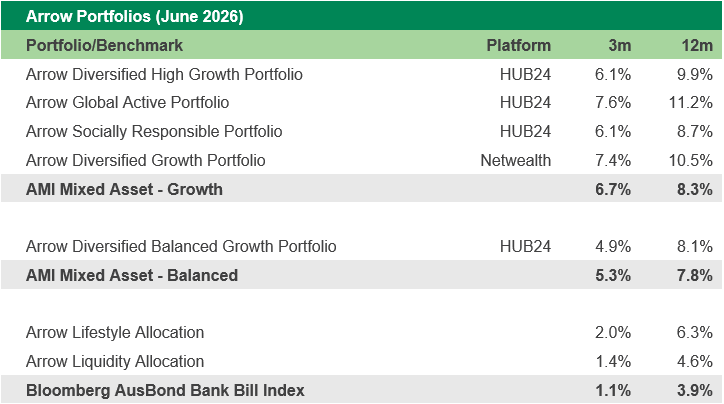
On the defensive side, our allocations targeting cash plus 1% and cash plus 2% over one- and three-year horizons respectively continue to deliver stable, consistent returns, despite some softer outcomes from the Liquidity Allocation. These allocations are designed to provide reliability for clients with shorter investment horizons or lower risk appetites, and continue to play an important stabilising role within diversified portfolios.
A classic comparison at this time of year is against industry superannuation funds, which generally publish their results on a financial-year basis. At the time of writing, not many funds have come forward with their returns as yet, but we'll draft up some comparisons as that information becomes available. Without knowing the numbers I would suspect our results hold up relatively favourably in comparison.
From a portfolio positioning perspective, not much has changed since the last note. The most substantial change at the portfolio level was the unwinding of some of our currency hedging, which is now targeting a 50% hedge ratio, still above our neutral position of 40%, but well below the highs of recent years, which reached 65%. There have been some tweaks within asset classes, but the overall asset class allocations have remained largely consistent since our purchase of Australian equities in March. Our focus remains on maintaining a measured and cautious outlook, managing valuation risks while continuing to support our clients' long-term return objectives.
Should you have any questions about anything covered in this letter, please don't hesitate to get in touch. We're always happy to discuss in greater detail.
Kind Regards,
Ryan Synnot
Head of Investment Management
Arrow Private Wealth
Similar Insights

Latest Insights

General Advice Warning:
Any general advice in this email does not take account of your personal objectives, financial situation and needs, and because of that, you should, before acting on the advice, consider the appropriateness of the advice, having regard to your objectives, financial situation and needs.