Understanding Investment Bonds
Investment bonds, also referred to as insurance bonds or growth bonds, have traditionally flown under the radar in Australia as a means of building long-term wealth. However, they’ve regained attention over the past 12 months due to renewed focus from the government on Division 296 reforms and the proposed taxation of unrealised gains on super balances exceeding $3 million. Under the right conditions and for suitable investors, investment bonds present compelling tax advantages along with reduced administrative burden, making them a valuable consideration for many investments.

What Are Investment Bonds?
An investment bond is a long-term investment vehicle offered by life insurance companies, allowing individuals to access a variety of managed funds through a tax-effective structure. While it operates similarly to a managed fund, its key distinction lies in how tax is handled: earnings within the bond are taxed internally at a maximum rate of 30% and, provided specific rules are followed (such as the 10-year rule), investors are not required to declare annual income on their personal tax returns.
Because of these features, investment bonds are an attractive option for a diverse range of investors, including:
High-income earners: seeking tax-effective investment options outside of superannuation.
Individuals who have maximised their superannuation contributions: and are looking for alternative wealth-building strategies.
Parents and grandparents: aiming to fund future education expenses in a flexible, tax-efficient manner with a low administrative burden.
Estate planners: who value simplicity and seek a tax-effective vehicle for intergenerational wealth transfer.
Things to Know
While investment bonds offer a straightforward and tax-effective structure once established, there are several important rules and quirks that investors should carefully consider before committing:
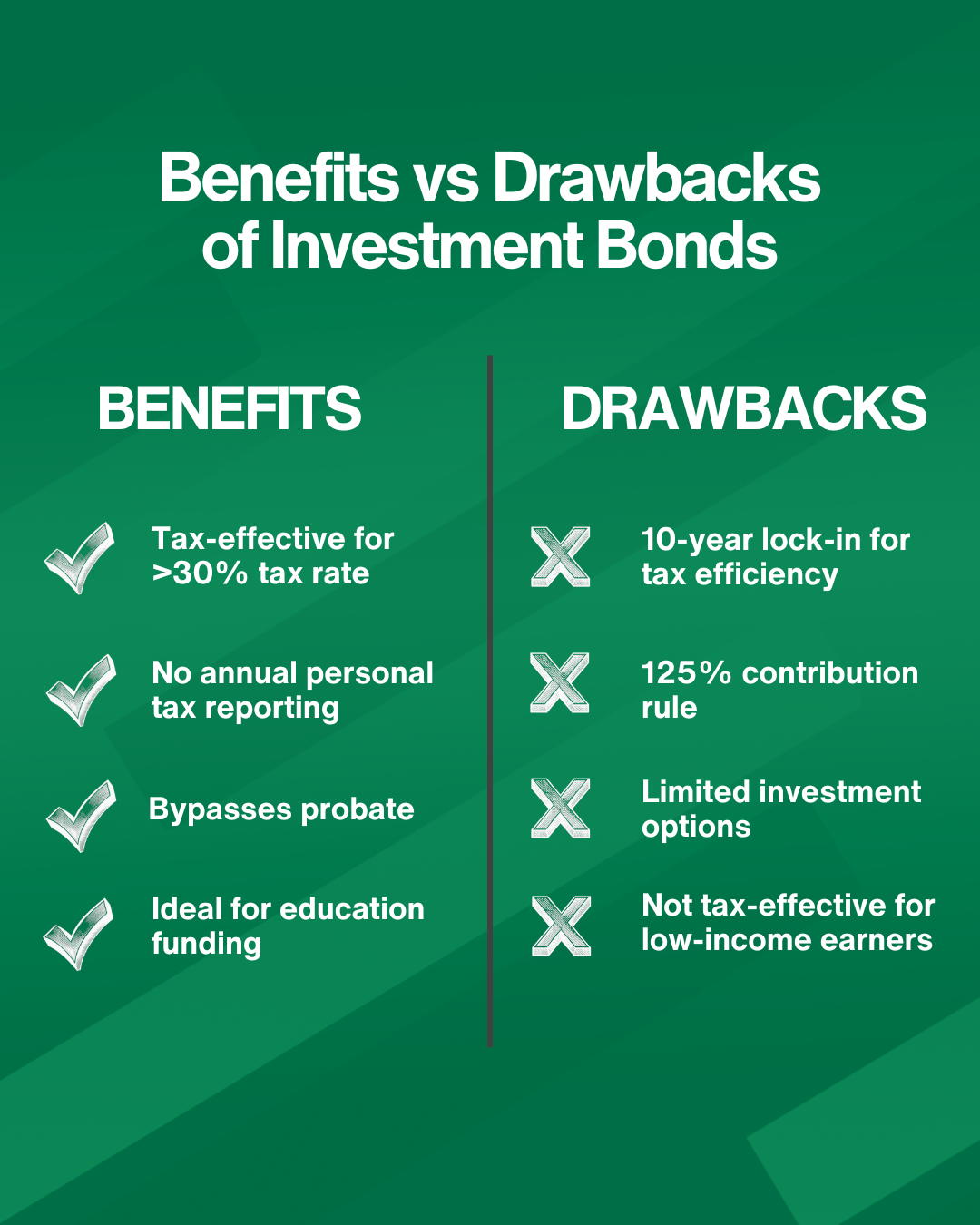
10-Year Rule: Withdrawals made after the bond has been held for at least 10 years are entirely tax-free for the investor. If withdrawals are made earlier, some tax may apply depending on the timing.
Tax-Paid Structure: The bond issuer pays tax on investment earnings at a flat rate of 30%. This can be particularly beneficial for investors whose marginal tax rate exceeds this level.
Contribution Limits: Additional contributions are allowed annually, but must not exceed 125% of the previous year’s contribution. Exceeding this cap resets the 10-year tax-free period, potentially delaying tax benefits.
Investment Choice: Investors can typically choose from a range of diversified investment options, including growth, balanced, and conservative portfolios, offering flexibility to match risk tolerance and financial goals. However the range of investment options is more limited than a traditional investment account.
Pros of Investment Bonds
Tax Efficiency: Ideal for investors on high marginal tax rates (over 30%), particularly if they hold the bond for over 10 years. Additionally, no personal tax reporting required annually – this is a big bonus for those wanting to keep things simple.
Estate Planning Tool: Proceeds can be distributed tax-free to nominated beneficiaries upon death. Bypasses probate, offering faster distribution.
Education Funding: A popular structure for parents or grandparents saving for children’s private education. Withdrawals can be timed to align with schooling costs, potentially tax-free.
Simplicity and Privacy: Since annual returns don’t need to be reported, they offer a "set and forget" structure. Useful for those who prefer financial privacy or reduced tax administration.
Cons of Investment Bonds
Limited Liquidity: While withdrawals are allowed anytime, early withdrawals (before 10 years) can trigger tax penalties. Accessing funds within the 10-year period reduces tax advantages.
Investment Choices Are Restricted: You are limited to the funds offered by the bond provider. Less flexibility than a self-managed super fund or direct investments.
30% Tax Rate May Be Too High for Low-Income Earners: If you are on a marginal tax rate lower than 30%, investment bonds may be tax-inefficient compared to direct investment.
Complex Contribution Rules: Must adhere to the 125% rule or risk resetting the 10-year period.
Case Study: Using Investment Bonds for Future Education Funding
Client: Sarah, a 42-year-old marketing executive in Melbourne.
Scenario: Sarah earns $210,000 annually and is planning to fund her daughter Ava’s secondary and university education. Ava is currently 6 years old.
Strategy: Sarah decides to invest $10,000 annually into an investment bond with a growth-oriented fund, intending to do so for at least 12 years (until Ava turns 18).
Benefits:
As Sarah’s marginal tax rate is 45%, she avoids personal taxation on the bond’s earnings.
The bond issuer pays 30% tax on investment earnings, which is reinvested internally.
When Ava reaches high school and university age, Sarah can start partial withdrawals tax-free (after year 10).
Funds can be earmarked for education without being legally tied to Ava, preserving control.
Outcome: After 12 years, the investment has grown to approximately $165,000 (assuming a 6% annual return after tax). Sarah uses the funds to cover school and university expenses, avoiding both Centrelink impacts and personal tax complications.
As highlighted, investment bonds in Australia can be a powerful tool when implemented with the right strategy. While they may not suit every investor, they offer a compelling combination of tax efficiency, simplicity, and estate planning advantages. Understanding the structure, rules, and available options is essential to using this investment vehicle effectively.
To explore whether an investment bond aligns with your financial goals, we encourage you to speak with your Arrow Private Wealth adviser. They can provide tailored guidance based on your personal circumstances and help you determine if this strategy is the right fit for your broader wealth plan.
General Advice Warning:
Any general advice on this page does not take account of your personal objectives, financial situation and needs, and because of that, you should, before acting on the advice, consider the appropriateness of the advice, having regard to your objectives, financial situation and needs. Information contained on this page was correct at the time of posting.