
Market Summary | January 2020
MARKET OVERVIEW
Following a very strong 2019, Australian markets showed no signs of slowing down throughout January as the market posted its strongest return since February 2018.
Markets globally were relatively flat in comparison to the Australian exchange. However, local investors were still rewarded by a depreciating Australian Dollar which gifted sound returns to those holding foreign currency or foreign stocks.
UNITED STATES
As per expectations, President Trump managed to get through his impeachment trial unscathed as the republican majority overruled the case for impeachment. Trump is now odds on favourite to win a second term in the White House, with Michael Bloomberg and Bernie Sanders rounding out the top three presidential candidates according to the bookmakers.
After taking a big run in the final quarter of 2019, US equities were flat, after the Coronavirus outbreak caused markets to tumble in the final few sessions of January trading. The months standout performer was undoubtably Tesla who’s shares rose over 50%, as the company smashed analyst consensus for vehicle delivery.
On the trade war front, the ongoing outbreak of Coronavirus in China has averted the risk of a further escalation for now, but a full resolution remains unlikely until at least 2021.
The S&P 500 Index (USD) returned -0.16% for the month
The Dow Jones (USD) returned -0.99% for the month
ASIA
China remained in the headlines throughout January albeit for a different reason. On 31st December, the Chinese authorities had notified the World Health Organisation of an outbreak of Pneumonia in the Wuhan Area, a virus which we now know as Corona Virus or COVID-19. Today the country is in lockdown as both the number of people infected, and death toll continue to rise.
News of the virus’s spread had a pronounced effect on markets, with investors concerned about the flow-on effects to the real economy. Chinese tourists are the highest-spending in the world, so the effects of travel restrictions and quarantine will have an impact on all markets, with the tourism and travel sectors directly impacted.
As expected in line with the news, Asian markets had a difficult month as investors began to factor in yet another global risk.
The Hong Kong Hang Seng PR Index (HKD) returned -6.66%
The Nikkei 225 PR Index (JPY) returned -1.91%
The Shanghai Shenzhen 300 PR Index (RMB) returned -2.26%
EUROPE
On the 31st of January, a mere 1,317 days following the initial referendum, Britain finally left the European union. The two parties now have until the end of the year to sort out trade agreements, a deadline which is almost certain to be extended into the future.
The German statistics office reported that GDP grew by only 0.6% in 2019, down from 1.5% in 2018 and 2.5% in 2017. The government expects growth to improve to 1.0% in 2020, having cut its forecast from 1.5% in October.
The UK’s FTSE 100 PR Index (GBP) returned -3.40%
The German Dax (EUR) returned -2.02%
AUSTRALIA
We will begin to see the effects of the bushfires flow through to economic data over the next few months. Growth in NSW and Victoria will be impacted, following a direct loss of output, lost tourism, lower consumer and business confidence, and supply chain disruptions. Counteracting this, insurance payouts, donations and government support packages will likely provide an offsetting boost in the quarters ahead.
After strong Black Friday sales in November, retail sales pulled back more than expected in December following a disappointing Christmas season for retailers. The start of the new year hasn’t done anything to improve the disposition of Australian consumers. The Consumer Sentiment index fell further in January from 95.1 to 93.4, due in no small part to the effect of the bushfires.
Over January, the S&P/ASX 200 Index returned 5.0%, led by large cap shares. The Health Care sector (+12.0%) continued its remarkable run, building to a rolling 12 month return of 54.8%. In line with the leading sector, healthcare stock Polynovo was the indices top performer (+42.13%) following a strong period of growth.
The sectors worst performer was satellite imaging company Nearmap Ltd (-33.27%) who’s stock tumbled after they announced a downgrade in guidance for their upcoming earnings call.
MARKET RETURNS (LAST 12 MONTHS)
Recent performance has pushed the return of International equities ahead of Australian equities. Performance from equities remains in positive territory whilst returns from cash remain somewhat suppressed.
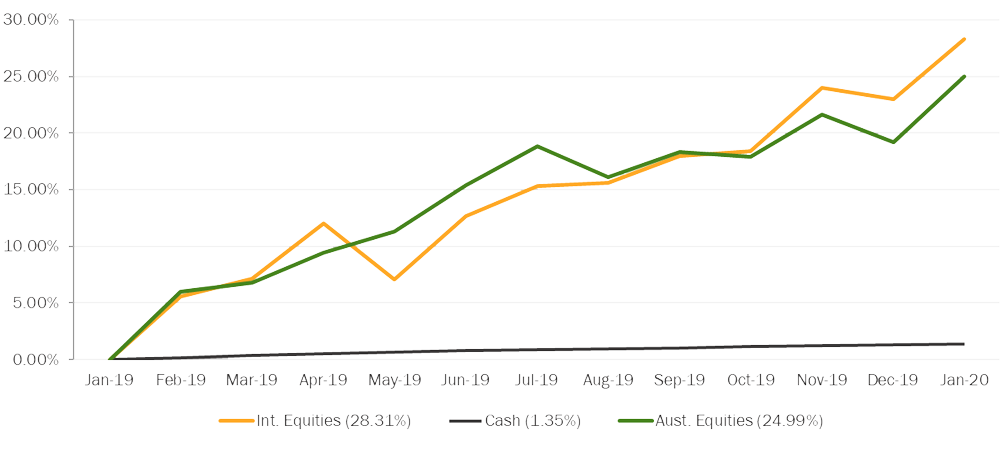
The above graph summarises the performance of the major financial markets and gives you an indication of how these markets performed over the last 12 months. The graph does not reflect your actual portfolio performance.