
Market Summary | February 2020
MARKET OVERVIEW
The focus over the past month has been almost entirely on the Coronavirus outbreak. New cases of the virus began to appear globally in February which has spread fear both across the globe and investment markets. Although markets were resilient for most of the month there were sharp falls towards the end of the month.
We saw markets begin to factor in the risks the Coronavirus outbreak presents. This includes significant disruption to global supply chains as a result of lock-downs & travel restrictions. Unsurprisingly this has taken a significant toll on the sectors most exposed to these risks such as tourism & aviation. With initial estimates assessing the toll to airlines would be in the 10’s of billions.
UNITED STATES
In the United States, Coronavirus fears rattled financial markets. The CBOE Volatility Index (VIX), known as the ‘fear gauge’, spiked to 49.5 points, its highest level since 2009. In an extraordinary move, we saw the Federal Reserve cut the funds rate by 50 basis points, its largest single move since 2008.
The virus is likely to have a significant effect on economic growth, coming at a time when the American economy is reasonably robust.
By the end of the month all sectors were deep in the red, the Communications Services sector (-6.3%) was the best performing, thanks to a bump from T-Mobile (+13.9%) following the approval of its merger with rival Sprint. There was also momentum from Netflix (+7.0%) and a small gain from Twitter (+2.2%) as the stock rebuilds after revenue and earnings misses in October.
The S&P 500 Index (USD) returned -8.41% for the month
The Dow Jones (USD) returned -10.07% for the month
ASIA
China produced more positive news throughout February as the nation managed to effectively contain the spread of the virus. China is now looking to reboot its industries after having to shut down large sections of the country for much of the year.
At this stage it is difficult to gauge the exact impact of the Coronavirus on Chinese growth. Consensus forecasts for Chinese GDP growth in the current quarter are variable but could be close to zero given the extended closure of industry, restrictions on people movement, and the disruption caused to supply chains.
Despite being the epicentre of the virus, China’s equities markets were more resilient throughout February on the hopes that authorities will continue to lower financing costs and possibly provide additional support to local industries.
The Hong Kong Hang Seng PR Index (HKD) returned -0.69%
The Nikkei 225 PR Index (JPY) returned -8.89%
The Shanghai Shenzhen 300 PR Index (RMB) returned -1.59%
EUROPE
The economic situation in the Eurozone looks more vulnerable to the Coronavirus crisis than other parts of the globe. Analysts suggest that the Eurozone GDP grew by less than 0.1% in the December quarter, marking it the slowest rate since the recession in 2012-13.
The outbreak, along with the combination of flagging growth and sliding inflation, means the ECB is almost certain to cut rates in the coming months and may also make changes to bank lending and look to increase the size of its bond-buying program.
The UK’s FTSE 100 PR Index (GBP) returned -9.68%
The German Dax (EUR) returned -8.41%
AUSTRALIA
Unfortunately, the Coronavirus and the policy response have come at a time when the Australian economy was showing signs of improvement and the budget was on a firm footing. There is a chance that the domestic economy will contract in the current quarter, prompting calls for fiscal stimulus.
The Australian economy is very exposed to the risks that the outbreak presents with key industries such as tourism and education likely to be severely affected. In 2018, Australia’s exports of travel services to China amounted to $16.2 billion, as these exports are either waived or delayed, we can expect to see declines in our economies GDP results.
Over January, the S&P/ASX 200 Index fell by 7.69%. Reporting season revealed several ASX companies have already been forced to make downward adjustments to guidance. Webjet (-18.6%) announced a cut to its FY20 EBITDA guidance in response to noticeable reductions in bookings.
On a positive note there were some companies who were able to navigate the storm and post good numbers for the month of February. Fisher & Paykel Healthcare returned 10.12% significantly outperforming the market. The result was off the back of increased demand for their products in China related to the Coronavirus outbreak.
MARKET RETURNS (LAST 12 MONTHS)
Recent performance has pushed the return of International equities ahead of Australian equities. Performance from equities remains in positive territory whilst returns from cash remain somewhat suppressed.
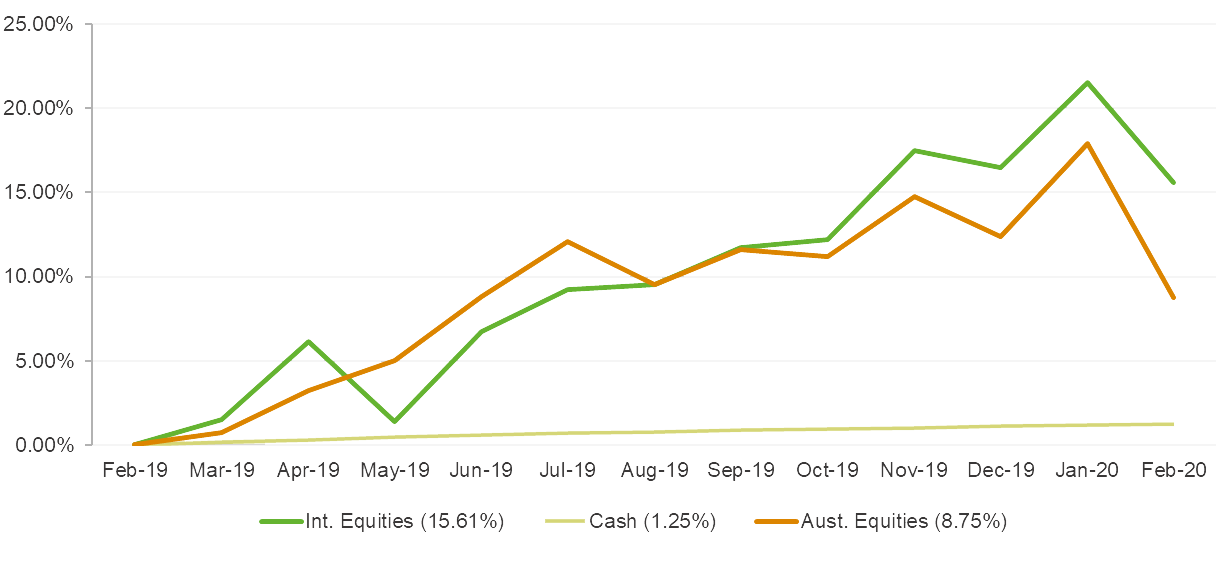
The above graph summarises the performance of the major financial markets and gives you an indication of how these markets performed over the last 12 months. The graph does not reflect your actual portfolio performance.