
Strategy Talk | May 2018
Australian demography is quickly changing. As is the affordability of housing for our younger generations. Is it a good idea to buy our children a home? Plenty to consider and more, in this month's Strategy Talk.

A GLIMPSE OF THE FUTURE
Demography is the study of population – births, deaths, ages, life spans, migration, and so on. Governments can record the changes but in free societies can do very little to change the overall trends. It’s a bit like the tide coming in – you can adjust where you sit on the beach but you can’t stop the water rising.
Research by worldwide organisations including the United Nations and European Union shows disturbing trends such as these:

In Australia, by 2020 there will be more people aged 65 than 1-year-olds. At this rate, there will never again be more children than grey heads.
In 1980 Australia’s median age was 29. By 2050 it will be almost 50.
By 2050, there will be only 2.7 people of working age to support each Australian aged 65 years and over. This is compared to 5 in 2010.
By 2055 there will be around 40,000 Australians aged 100 years or over.
By 2050 there will be twice as many older citizens in the world than children, with the exception of Russia and China.
The Causes
There are three irreversible demographic trends behind these figures. First is the bulge in retirement from the baby boomers (those born between 1946 and 1964). Many of the early baby boomers have either already retired or are close to it, and the late boomers are well into planning for their retirement. This bulge will guarantee a high proportion of older people in our society in the future.
Second is the fall in fertility rate. In developed societies we are not having enough babies to replace ourselves.
And thirdly, better nutrition and medical care means we are living longer.
The Outcomes
These three trends mean:
The number of employed people, ie. taxpayers, will dramatically reduce.
The number of retired people needing social security, health and aged care support will rise.
Government budgets will come under increasing pressure as society struggles with the problem of supporting a very large population of older people.
Financial systems will come under threat as retirees sell off their assets to fund their retirement.
Every nation’s medical and social security system depends on taxpayer money to fund its existence. Politicians may be unwilling to admit it but some unpopular decisions will have to be made. The simple choices are to raise taxes or restrict access to government benefits to only the neediest. The longer the decisions are delayed, the more difficult the transition will be.
The constant decline in birth rates will stunt the growth of national economies. As the consumer population decreases, production and product advancement will decrease due to a lack of demand, and economies will follow.
What does this mean for you?
Of course, it depends on your age and financial situation. Self-sufficiency in retirement should be a goal for everyone – nobody wants to be reliant on a heavily burdened and potentially restrictive welfare system. Being self-sufficient will give you the freedom to choose the lifestyle you want.
If you are a long way from retirement, make a commitment now to be a self-funded retiree. Investigate the many opportunities to accumulate a healthy superannuation balance by your preferred retirement age. With more time up your sleeve, the contributions can be far more manageable.
If you are planning on retiring soon, you may need to review what retirement means to you and look at other options such as working a few more years.
If you are already retired and rely on government benefits, you may need to consider learning new skills so you can supplement your pension and personal income with paid work.
This all sounds like a reality we would rather not hear, but like the tide coming in, there is not much we can do to stop it.
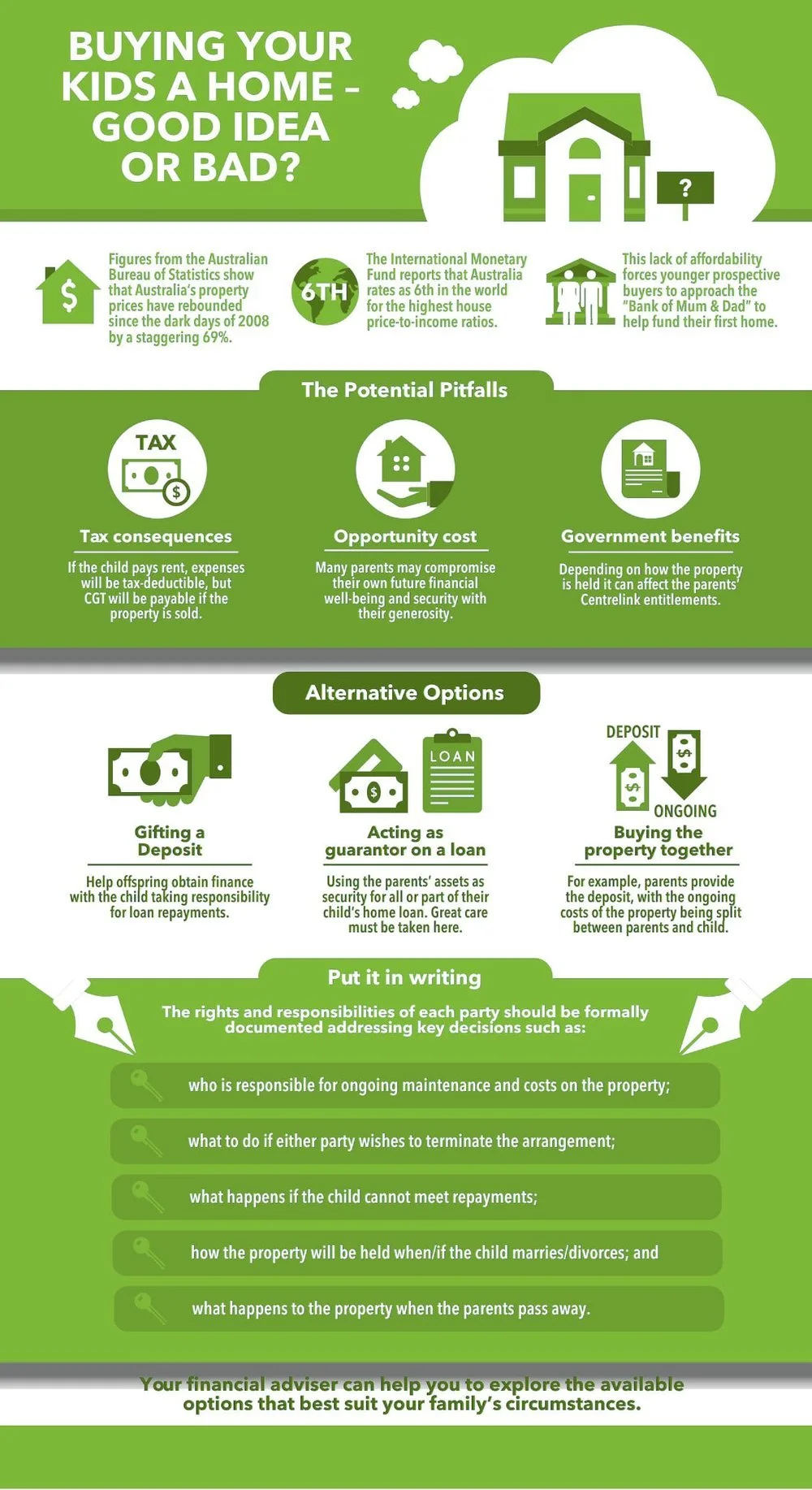
Buying Your Kids a Home - Good Idea or Bad?
FAST FINANCIAL FACT:
FEDERAL BUDGET 2018
Please remember that although the Federal Budget generates media frenzy, most of the major changes announced are only proposed changes. They will not come into effect until passed by both Houses of Parliament and receive the Governor General's Assent.
No doubt there will be much debate and media attention placed on these proposed changes, but until we advise you that the changes have become law and how they may affect your financial situation, we all just have to wait and see.
Stay tuned...