
Market Summary | May 2018
MARKET OVERVIEW
Despite increased volatility caused by rising geopolitical tensions, the markets generally performed well in May.
The difficulty in forming a government in Italy as well as the U.S. administration’s approach to international affairs prompted investors to shun certain regions of the globe. The exodus weighed on emerging markets but enabled fixed income to record a positive return during the month. In this context, the U.S. dollar rose against a large number of currencies. In return, the economic environment continued to be favourable, thanks to sustained growth and moderate inflationary pressures, and developed markets stock exchanges generally continued to progress.
UNITED STATES
US equities advanced in May, with economic and earnings data proving resilient enough to allow investors to shrug off an escalation in trade sanction uncertainties. Late in May, the Trump administration confirmed that it would proceed with steel and aluminium trade tariffs for Canada, Mexico and the EU, and also withdrew from the Iran nuclear deal. The more combative stance stoked fears of retaliation from major trade partners and did unsettle markets.
The retaliation from the EU saw tariffs imposed on a raft of US imports from Harley Davidson motorbikes to bourbon. There were no tariffs on Chinese goods as trade talks continued, but it now appears that the US will impose 25% tariffs on $50bn worth of Chinese imports shortly after mid-June, with Treasury Secretary Steve Mnuchin saying that a final list of goods would be published by the 15th of June. However, the positive tone set by economic data over the month allowed markets to stay ahead overall.
ASIA
There was bad news for the Japanese economy in May, with figures for the first quarter of 2018 showing that the economy had contracted by an annualised rate of 0.6%, worse than the expected contraction of 0.2%. This was the first time the Japanese economy had shrunk in two years, ending the longest stretch of economic growth since the 1980s.
The Chinese Government finally agreed to significantly increase the number of goods it buys from the US. A joint statement between the US and China stated that the two countries had agreed to a ‘meaningful increase in US agriculture and energy exports’.
EUROPE
The European Central Bank (ECB) kept monetary policy unchanged, as expected. In his statement, ECB president Mario Draghi highlighted still-subdued inflation and the recent moderation in economic data.
Political uncertainty in Italy dominated market moves. The populist Five Star Movement and the League appeared close to forming a government but President Sergio Mattarella blocked the appointment of a Eurosceptic finance minister proposed by the two parties. This triggered a sell-off of Italian assets by investors fearing a snap election, although the two parties rekindled to form a coalition government by the end of the month. The new Government also announced it will tackle Italy’s high levels of debt, but has ruled out an exit from the Euro, much to the relief of markets.
AUSTRALIA
The Reserve Bank of Australia left the cash rate anchored at 1.5% at its early June meeting and judging by the most recent Statement on Monetary Policy, it is unlikely to change course any time soon. Ongoing low wages growth, uncertainty over the extent and impact of the recent tightening in home lending conditions, and inflation barely in the bottom of the RBA’s target range suggest that it would be premature to begin exiting current accommodative policy settings.
The Federal Budget delivered in May showed an improved deficit position for the coming fiscal year and an earlier return to surplus, but it was the proposed changes to individual taxes that was the real draw card.
MARKET RETURNS (LAST 12 MONTHS)
Markets have had a positive 12 months. Returns have been positive in all growth asset classes. Equity markets generally have performed well while fixed income and cash returns remain at historically low levels. The month of May provided positive returns across the asset classes with stronger performance coming from International & Australian Equities.
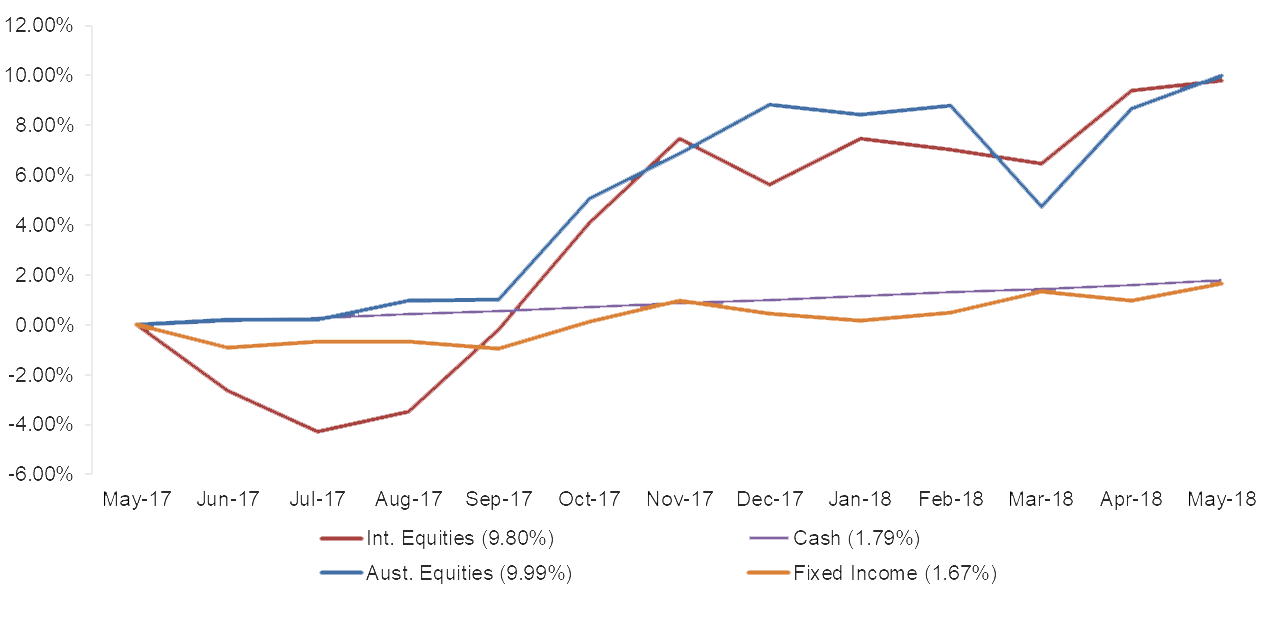
The above graph summarises the performance of the major financial markets and gives you an indication of how these markets performed over the last 12 months. The graph does not reflect your actual portfolio performance.