Strategy Talk | June 2018
For the first time in 2018, the days are getting longer. It must be tax time. What will you do with your tax refund? How will the federal budget affect your SMSF? Lots to think about in this month's Strategy Talk.

HOW THE 2018 FEDERAL BUDGET WILL IMPACT SMSFS
Source: FS Advice, Daniel Butler & Christian Pakpahan
We outline the key superannuation changes announced in the Federal Budget 2018 on 8 May 2018. Some of the proposed changes will have a substantial impact on SMSFs if they are finalised as law.
Nomination of superannuation guarantee ('SG') for certain employees with multiple employers
Broadly, members with incomes above $263,157 with multiple employers can decide whether certain employers do not need to provide SG contributions in respect of their wages from 1 July 2018.
This measure may give a solution to those who unintentionally exceed their concessional contributions cap due to multiple compulsory SG contributions. This can give rise to members being liable to pay tax personally (less a 15% tax offset) on their excess concessional contributions to the extent their overall concessional contributions for the financial year ('FY') exceeds the $25,000 cap. Moreover, the shortfall interest charge and other amounts can become payable on excess contributions.
Members who are interested in using this measure should consider negotiating with their employers to receive what would otherwise have been provided by way of SG contributions as additional income, which is taxed at the employee's marginal tax rates plus applicable levies. These negotiations should occur as soon as practicable given this measure is proposed to apply from 1 July 2018.
While this is a positive and long overdue measure, members with only one employer do not appear to obtain this flexibility.
Work test exemption for the newly retired
For recently retired members between the ages of 65 and 74 with superannuation balances under $300,000, there will be some relaxation from the work test for voluntary contributions to superannuation.
Under current law, a person who attains 65 must generally be gainfully employed for at least 40 hours in a period of not more than 30 consecutive days in that FY before they can contribute to a superannuation fund. A member is 'gainfully employed' if they are employed (including self-employed) for gain or reward in any business, trade or profession.
The proposed relaxation is for the first year they do not meet the work test requirements and starts from 1 July 2019. Total superannuation balances will be assessed for eligibility at the beginning of the FY following the year they last satisfied the work test and there is no requirement for members to remain under $300,000 once the member is eligible.
The usual concessional and non-concessional contribution ('NCC') caps will continue to apply however members may also be able to apply the concessional contribution cap carry forward rules during the 12 months and contribute more than their annual concessional contribution cap. It should be noted that the NCC bring forward rule is generally not available for members over 65 years of age.
FAST FINANCIAL FACT:
MY DEDUCTIONS APP MAKES TAX TIME EASIER
Did you know that the Australian Tax Office offers an app called MyDeductions to make tax time easier?
Working on your smart device, MyDeductions assists individuals by instantly recording their expenses. Sole traders can upload business income information. The app also stores images of receipts, overcoming the problem of lost or faded receipts.

When tax time arrives, you simply send the data file to your accountant or tax agent.
To download the app and for more information visit the ATO website. Life just became a little bit easier!
WHAT WILL YOU DO WITH YOUR TAX REFUND?

Thousands of Australians receive tax refunds every year. Some refunds won’t even cover the cost of a pizza to celebrate, however many are quite substantial. If you’re one of the lucky ones, what will you do with your tax windfall?
If you go out and spend it, all you’re doing is giving part of it back to the government in the form of GST. Sure it’s nice to splurge once in a while but there are other places you can stash your cash and reap a longer term benefit. Consider these options:
a) Reduce your mortgage
By paying it straight into your mortgage, you immediately acquire more equity in your home and reduce the interest. Having more equity in your home also means that you can re-borrow that money again for investment, gearing, or to purchase other assets. So that’s an option that could keep on working for you.
b) Regular investment plan
Consider investing the lump sum and setting up a regular savings investment plan to build it up. This will help you meet future objectives such as a new home, education or new car.
While a certain amount of money in the bank is helpful for emergencies, now could be the time to consider a longer term plan with assets such as property or shares. You can invest in a managed fund with an initial deposit of $1,000 and make monthly contributions. While such investments are subject to fluctuations in value, you will see them grow over time. There are also likely to be tax benefits from franking credits.
c) Superannuation contributions
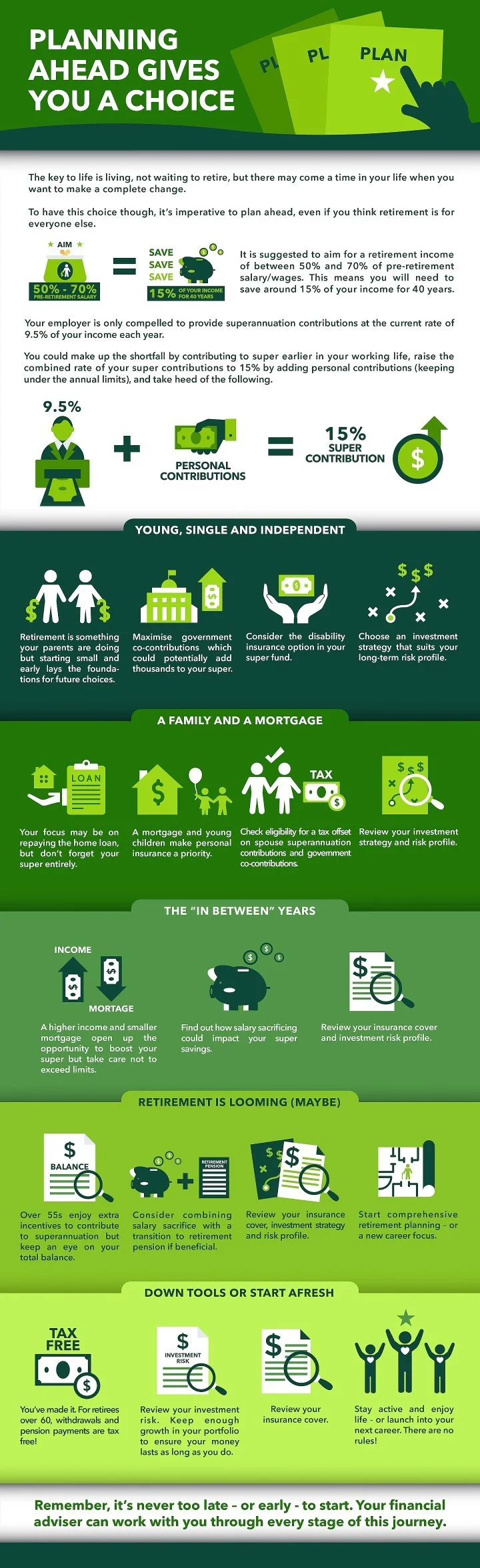
Your superannuation fund will surpass any other investment vehicle simply due to the law of compounding... and your contributions are taxed at only 15% (on income less than $300,000 per annum). Whilst superannuation funds remain the most tax-effective haven and thus the best way to grow your investments, the downside is that once your money is contributed it’s usually not accessible until you retire.
The moral of this story is to have a plan and then apply it. Work out where your tax refund will work best for you then talk your decisions through with us.