
Market Summary | September 2021
MARKET OVERVIEW
September saw an evaporation to the gains made in global markets over the last three months, with developed and emerging markets receding by 3.1% and 2.8% in Australian Dollar terms, respectively.
Contraction in performance over September was primarily driven by fears of a global financial contagion stemming from the worlds most indebted company, the Chinese based Evergrande Group, after news that it was renegotiating coupon repayments on its US$300b of outstanding debt.

Evergrande Group expressed financial troubles concerning their debt position
United States
As widely expected, during its September meeting, the Federal Reserve left the target for its federal funds rate unchanged at 0.00-0.25%. The FOMC noted that a moderation in the pace of asset purchases may soon be warranted if the economic recovery continues to progress.
Additionally, investor sentiment was dented by rising energy inputs and a change in central bank rhetoric, many of whom have begun striking a more hawkish tone. This includes the Fed, who have signalled that the time to taper back on extraordinary levels of stimulus, may be near. Bond yields have risen in anticipation of higher inflation which has unsettled investors in recent weeks, leading many to question if current asset valuations are sustainable.
The S&P 500 Index (USD) returned -4.76%
The Dow Jones (USD) returned -4.29%
Asia
Chinese equities faced an array of difficulties throughout the month as sentiment was further hit when property development giant Evergrande expressed financial troubles concerning their debt position. This follows a difficult period for Chinese equities, following an array of regulatory restrictions imposed by the Chinese Communist Party across the education sector, which spooked markets earlier in the year.
Japan was the world’s best-performing equity market over the past month, after the resignation of Prime Minister Yoshihide Suga raised the prospect of fresh fiscal stimulus in the country. The ruling Liberal Democratic Party voted on a new leader on 29 September, with some of the candidates calling for a supplementary budget in the “tens of trillions of yen.”
The Hong Kong Hang Seng PR Index (HKD) returned -5.04%
The Nikkei 225 PR Index (JPY) returned 4.85%
The Shanghai Shenzhen 300 PR Index (RMB) returned 1.26%
Europe
In the UK, as widely expected, during its September meeting the Bank of England left its policy rate unchanged at 0.1% and its quantitative easing program has been maintained at £875 billion.
As expected, the unemployment rate fell 10bps to 4.6%, but Britain’s worst labour market shortages in decades are being driven by employers struggling to recruit low paid workers, such as in road transport and warehousing. Vacancies in other areas are still significantly below pre-pandemic levels.
UK’s gas prices have quadrupled in the last year to record levels, causing several suppliers to go bust as they cannot pass these increases on to consumers, due the government price cap. Factories running for fewer hours to cut energy costs is also having an impact. This has intensified supply chain pressures caused by a lack of qualified truck drivers.
The UK’s FTSE 100 PR Index (GBP) returned -0.47%
The German Dax (EUR) returned -3.63%
Australia
The RBA minutes for its September meeting revealed the bank still expects to keep rates at 0.1% until at least 2024 as it struggles to lift wage growth and inflation. The board noted that the outbreak of the delta variant has interrupted the economic recovery in a manner that was more severe than expected a month prior, with GDP expected to decline materially in Q3. Retail sales fell 1.7% in August, as widely expected.
The Australian share market finished lower in September, ending an impressive 11-month run of gains, with the S&P/ASX 200 losing 1.9% for the month. The Energy sector benefitted from rising coal and oil prices, with the sector up 16.7% for the month.
Falling iron ore prices, which have been impacted by Chinese production cuts across the steel manufacturing industry, have weighed on local mining heavy weights which account for roughly a fifth of the Index. Iron ore prices have also been adversely impacted by the financial woes of Evergrande, China’s second largest property developer. The Chinese construction sector accounts for roughly half of all China’s steel consumption and should Evergrande fail, the impact is expected to be felt across other Chinese property developers, which will likely contribute to a further reduction in demand for iron ore.
Market Returns (last 12 Months)
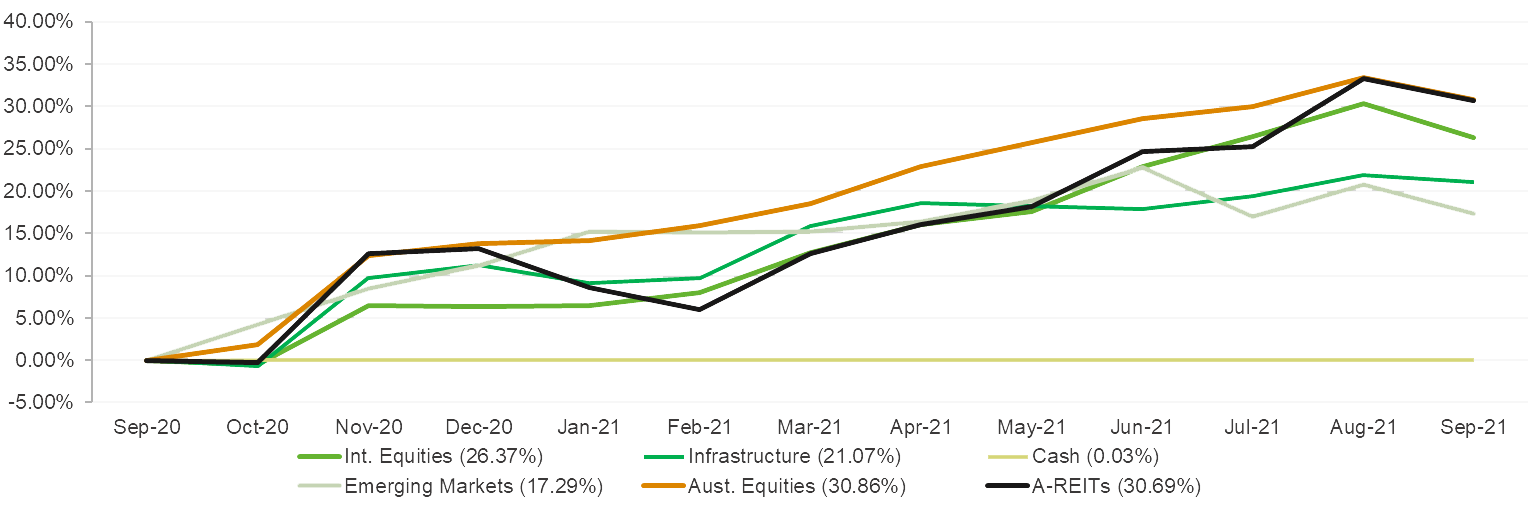
The above graph summarises the performance of the major financial markets and gives you an indication of how these markets performed over the last 12 months. The graph does not reflect your actual portfolio performance.
*Source: Lonsec Research Pty Ltd