
Market Summary | October 2018
MARKET OVERVIEW
October confirmed a resurgence in volatility for equity markets, which has been reflected in a divergence in returns between regions, sectors and securities alike. For some period, volatility has been subdued by liquidity being pumped into global markets in the form of quantitative easing (QE).
With central banks unwinding their QE programs, the focus on equities will be increasingly on future earnings growth and individual stock quality.
We believe that the increased volatility in markets will create opportunities for quality active investment management, and portfolio diversification will become increasingly important. The bull market we have experienced in recent years has been conducive to growth and price momentum factors.
UNITED STATES
The US economy hit a record high in early October pushing above 28,600 points for the first time in history following the finalization of a trade deal between the US, Mexico & Canada.
Despite the early rise in equities the US market was sold off significantly during the remainder of the month. Some of the hardest hit names included ‘New’ Media stocks Twitter (-19.1%) & Facebook (-6.4%) with debate raging about whether the selloff was predominately technical or driven by fundamentals.
The S&P 500 fell -6.94%.
ASIA
Chinese GDP growth failed to meet expectations for the September quarter of 2018 as activity slowed, notably the manufacturing and infrastructure sectors (which have been staples for the Chinese economy) both slowed. As a result, the People’s Bank of China has cut reserve requirements for lenders, injecting more liquidity into the market to accelerate growth.
The total impact of tariffs on Chinas growth still remains unclear, however many economists have cut their growth numbers for the economy. The IMF recently downgraded Chinese GDP growth in 2019 from 6.4% to 6.2%, citing trade as a key issue.
Japan’s Nikkei 225 Index fell -9.12%.
Hong Kong’s Hang Seng fell -10.11%.
EUROPE
European markets broadly tracked other markets falling for the month of October. German Chancellor Angela Merkel plans to step down from her position in 2021 having been in office since 2005. A change in Europe’s throne may come sooner than expected with Merkel’s party having lost their long-held majority in Bavaria. The German market was down 7% for the month and is now down 11% on the year.
Brexit negotiations didn’t progress any further in October with politicians continuing to disregard any proposal made by Prime Minister Theresa May. A deal is looking increasingly unlikely before the impending deadline with discussions of another vote beginning to surface. The UK has further negotiations scheduled with the EU in November.
The UK’s FTSE 100 was down -5.09%.
AUSTRALIA
Despite the risk of a material slowdown in the Chinese economy, evidence of a decline in house prices, and global trade concerns, business conditions remain relatively robust while labour market conditions continue to show signs of underlying strength.
Minutes from the RBA meeting signalled a heightened risk in the housing market, raising the possibility that banks could tighten lending conditions further in light of the Royal Commission into Financial Services report.
The ASX 200 was down -6.05% in October, sectors that have enjoyed a relatively robust earnings trajectory in recent months, such as Health Care (-7.0%) and Information Technology (-11.2%), were hit hard as investors backed away from elevated valuations.
Small cap starlet Afterpay Touch Group (APT) declined -30.4% for the month of October off the back of an enquiry into responsible lending. Corporate Travel Management (CTD) was the indices worst performer falling -34.3% as the stock became heavily shorted by some notable investors.
MARKET RETURNS (LAST 12 MONTHS)
Despite the negative month markets have had a positive 12 months. Returns have been positive in all growth asset classes.
The month of October provided negative returns across equity markets. There is now a significant gap in performance between International & Australian Equities.
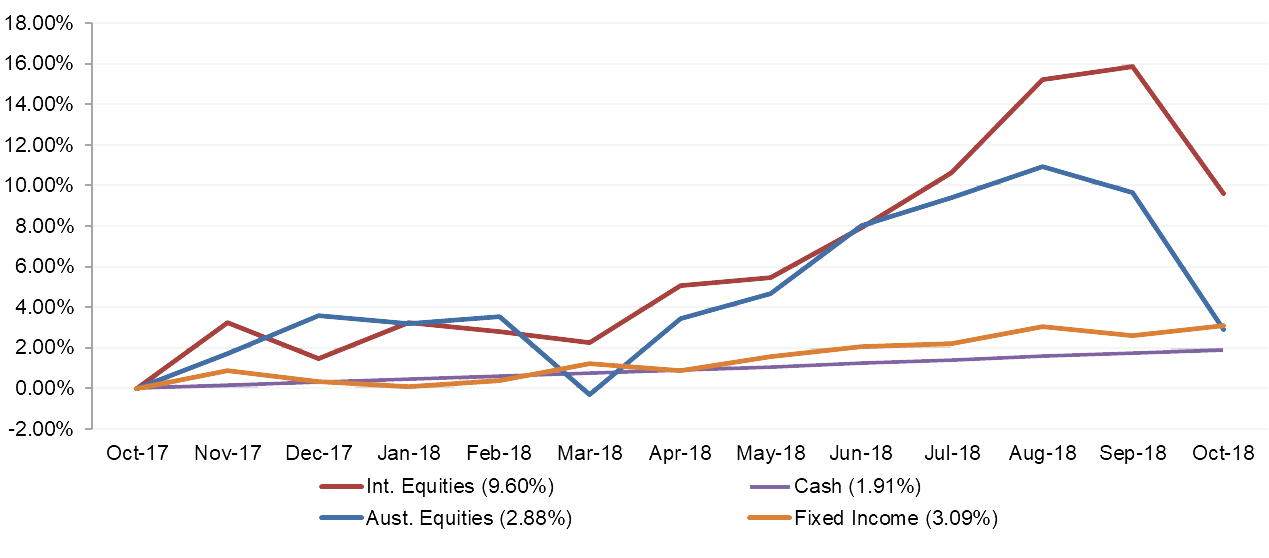
The above graph summarises the performance of the major financial markets and gives you an indication of how these markets performed over the last 12 months. The graph does not reflect your actual portfolio performance.