
Market Summary | July 2022
MARKET OVERVIEW
Global equity markets rebounded in July as markets lowered their expectations for rate hikes and bond yields rallied. In a sense, poor economic news was good news for equities. With the aggressive Fed policy tightening raising the risk of recession and signs of an easing in commodity prices and supply chain issues, markets cut their expectations of “peak” Fed funds from around 3.5 percent to 3.25% while 10-year treasury yields rallied from just under 3 percent to 2.67 per cent.
This helped support growth stocks, which had been undermined over recent months against a backdrop of rising real yields. Some better-than-expected earnings results, particularly in the large cap, tech space, also supported the market.

UNITED STATES & DEVELOPED MARKETS
The MSCI World ex-Australia index rose 8 per cent in USD terms, cutting the year-to-date loss to 14.4 per cent and the annual decline to 9.2 per cent. In AUD terms the index was up 6.4 per cent for the month, down 10.8 per cent for the year to date and - 4.3 per cent for the year.
All eyes remain on inflation. The June CPI showed prices rising 1 per cent for a 9.1 per annual gain. The employment cost index was up more than 5 per cent for the year. However, with the Fed funds rate projected to reach 3.25 per cent year-end, around 75 basis points above neutral estimates and recession risks rising, market implied inflation expectations stabilised earlier in the month.
On the US earnings front, more than half of companies have beaten expectations, above the long-term average but below the levels of recent years. Large tech firms have fared relatively well while consumer discretionary earnings appear to be under pressure due to declining consumer confidence, high inventory levels and rising prices.
In terms of regions, the US led the way with a 9.3 per cent gain while the smaller markets of Sweden (up 11.3 per cent) and Netherlands (up 10.4 per cent) also stood out. Europe ex-UK was up 5.4 per cent in July but is down 20.1 per cent for the year to date. Japan was 5.7 per cent higher for the month but is down 15.7 per cent so far this year. For the year to date the better relative performers have been Norway, UK, Canada and Australia, markets with a larger commodity exposure. Hong Kong has also performed relatively well.
ASIA
Emerging markets did not participate in the rally in July, held back by weakness in China, which was down 9.5 per cent for the month on concerns over the growth outlook, a reluctance of the policymakers to provide meaningful stimulus and the risk of further lockdowns.
Emerging markets are often viewed as risk-on markets, leveraged to the global cycle, and exposed to a rising USD. All these factors remain dominant negative drivers at present although counter to that, the Chinese policy cycle and inflation picture is diametrically opposed to most developed markets at present. The Chinese growth outlook would appear to be modestly improving, with incremental policy easing providing a partial offset to the impact of lockdowns, a weaker housing and property sector and rising unemployment. Interestingly, the only countries with central banks to have eased policy in recent months are China and Russia.
Of course, the direction of the Chinese market matters most for the EM index. At present conditions are clouded by the weakness in the property sector and the zero-Covid policy, not to mention policy risk leading into the 20th National Congress of the Chinese Communist Party (CCP) in November.
AUSTRALIA
The Australian equity market once again underperformed global markets, gaining just 5.75 per cent in July, compared with 6.4 per cent for unhedged global equities and 8 per cent for hedged Global equities.
The RBA pressed on with tightening, lifting rates by 0.5 per cent to 1.35 per cent, while also telegraphing more to come. Higher than expected inflation data combined with strong labour market data has strengthened the resolve of the RBA to do what is necessary to bring inflation under control. At a minimum it suggests the need to quickly get policy back to the neutral estimate, around 2.5 per cent. Indeed, with a further 50 basis points expected in August, the RBA could have policy back to neutral in the September quarter. Markets currently expect the RBA to move into restrictive territory, reaching 3 per cent by year-end. This would be one of the most aggressive hiking cycles on record, notwithstanding it represents a de-escalation from the 4 per cent plus expected by markets back in June.
Despite the news of high inflation, a tight labour market and signs of slowdown in the global economy, equities managed to stage a significant rally. Sectors that have been hard hit over recent months recorded the biggest rebound. Retailers rose 12.5 per cent but are down 20.5 per cent year to date while REITs jumped 11.9 per cent as real yields declined. REITs are down 14.4 per cent year to date. Materials were largely flat despite softer commodities (oil down 4.3 per cent, iron ore off 4.1 per cent) while banks surged 10.4 per cent to be up 0.6 per cent for the year, extraordinary considering the sell-off in banks globally and the concerns around domestic house prices and household debt levels.
For now, the focus for equity markets is entirely on inflation and the risk of recession associated with the aggressive policy response. Markets have priced in a high probability of a mild recession although the depth and duration of any economic and earnings downturn largely depends on the trajectory for inflation globally as we head into 2023. While supply-side and commodity price pressures have eased somewhat and the economy is slowing, tight labour markets and rising wages growth risks spilling over into higher inflation expectations which at present remain relatively well anchored and in fact, have been declining over recent weeks. The RBA continues to focus on keeping a lid on inflation expectations stating, “The board is committed to doing what is necessary to ensure that inflation in Australia returns to target over time.”
ASSET CLASS RETURNS (LAST 12 MONTHS)
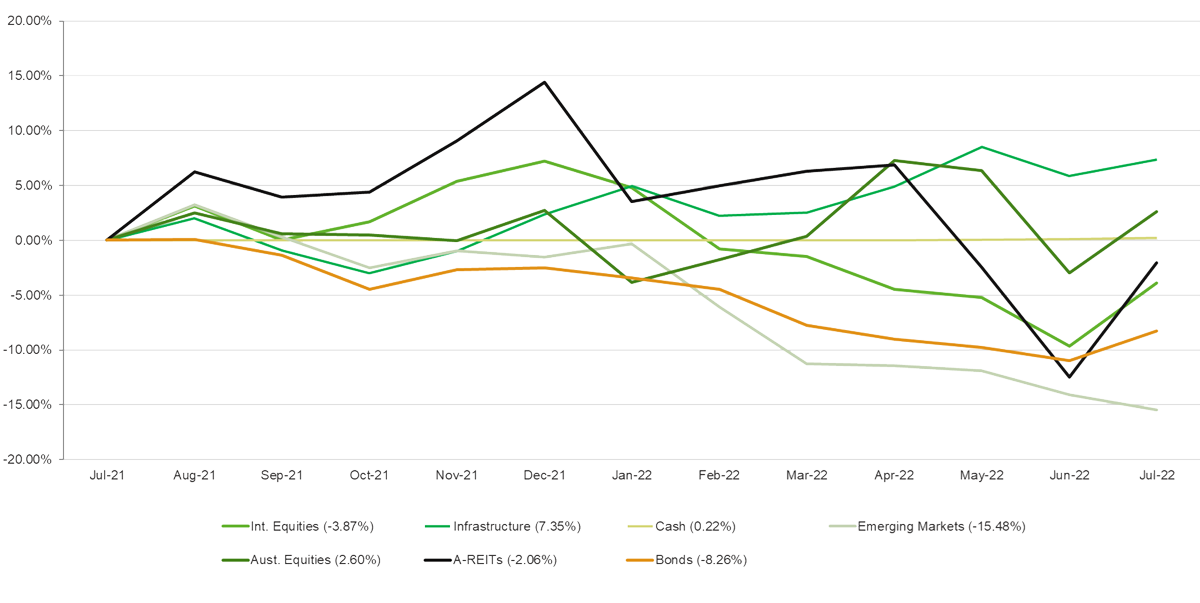
The above graph summarises the performance of the major financial markets and gives you an indication of how these markets performed over the last 12 months. The graph does not reflect your actual portfolio performance.
*Source Zenith Investment Partners