
Market Summary | August 2022
MARKET OVERVIEW
After a significant rally from mid-June to mid-August, global equity markets lost ground over the second half of August as real bond yields moved higher and markets increased their bets that central banks were likely to maintain restrictive policy settings for longer than earlier thought.
US Fed chairman’s Jackson Hole speech in late August reminded investors that the Fed’s focus was squarely on inflation. Equity markets responded negatively to the speech while the bond market reassessed its earlier expectation that policy could be easing in 2023.
After rising 8 per cent in July the MSCI World ex-Australia index dropped 4.25 per cent in USD net terms in August, taking the year-to-date loss to 18 per cent. In AUD terms the index was down 2.5 per cent for the month and down 13 per cent for the year to date.

UNITED STATES & DEVELOPED MARKETS
After hitting a low of 3666.77 on June 16, 23.5% below the early January peak, and qualifying as a new “bear market”, the S&P500 reached a peak of 4305.2 on August 16 (a 17.4 per cent recovery) before ending the month at 3955, around 18 per cent below the January peak. Bond yields have largely mirrored the changing fortunes of the equity market with the US 10-year yield peaking at 3.49 per cent on June 14, rallying to 2.67 per cent by the end of July before rising to 3.15 per cent by the end of August. While the market may now be “comforted” by the Fed’s inflation fighting credentials, reflected in relatively stable long term inflation expectations, the likelihood of “higher for longer” Fed funds and the associated downside risks to growth are now being priced into equity and bond markets.
In terms of economic data, the most interest rate sensitive sectors of the US economy continue to weaken. New home sales are 50 per cent below late-2020 peaks, existing home sales are down 30 per cent while starts have dropped 19 per cent. Despite a lift in August, US consumer confidence is at recessionary levels. The good news is that price pressures, as measured by ISM prices and supplier delivery times, are easing. Payrolls continue to beat expectations and although the unemployment rate rose to 3.7 per cent in August, the labour market remains tight and wages growth hovers around 5.2 per cent. On the inflation front, the news was slightly better. The July CPI showed prices declining during the month, taking the annual rate to 8.7 per cent from 9.1 per cent.
Meanwhile, Europe continues to deal with soaring energy costs, high inflation and an expected recession. Europe’s inflation rate for August hit 9 per cent while in the UK the CPI exceeded 10 per cent. Manufacturing PMI readings in Europe and the UK are around 50 at best while service sector PMI readings continue to slide.
At the sector level, energy was the only sector to rise, up 1.7 per cent while healthcare was down 6 per cent, IT 5.9 per cent, retailers 4.4 per cent and banks 2.2 per cent. For the year to date the communications sector is down 28.7 per cent with IT and retailers off more than 25 per cent while energy has risen 34.8 per cent.
EMERGING MARKETS
Emerging markets outperformed developed markets in August, rising 0.4 per cent in USD terms and 2.2 per cent in AUD terms. For the year to date, emerging markets are down 17.5 per cent in USD terms and 12.5 per cent in AUD terms, slightly ahead of global developed markets.
The better performance of emerging markets during the month reflected a stabilisation in China’s equity market and stronger performance from Latin America, led by a 6.4 per cent gain in Brazil. EM Asia was up 0.4 per cent, assisted by a 0.2 per cent gain in the MSCI China index and a 4.1 per cent rise in India. EM Latin America was up 2.7 per cent for the month and 6.5 per cent for the year to date, assisted by a higher commodity exposure.
The Chinese equity market is down 19.5 per cent year to date. The economy continues to be impacted rolling Covid lockdowns and by the property sector downturn, with many measures of activity and sales down by 20-30 per cent. In recent years, the government has intervened to curb speculation, and rein in what it calls the “three high” problem: high prices, high debt and high financialization.
Property developers have been under enormous pressure, particularly those that were already highly leveraged as a result of a deterioration in funding conditions. Some developers have suspended construction of large residential projects leading some home buyers to withhold related mortgage payments, in turn, further restricting funding. In response to ongoing weakness, during August, China's State Council rolled out a trillion yuan package in economic stimulus. The latest US$146 billion in assistance targets infrastructure, property, and private business. It includes an additional $44 billion for State banks to finance infrastructure projects. However, along with the recent surprise 10 basis point cut in interest rates, these measures are seen as insufficient to shift the dial for growth in any meaningful way.
AUSTRALIA
The Australian equity market outperformed global markets, gaining 1.2 per cent in August, compared with -2.5 per cent for unhedged global equities and -3.6 per cent for hedged global equities. For the year to date, however, the Australian market is down just 3.6 per cent compared with -13 per cent for unhedged global equities and -16.1 per cent for hedged global equities.
The RBA lifted the official cash rate by a further 0.5 per cent in August to 1.85 per cent and hiked a further 50 basis points at the September meeting to 2.35 per cent. In announcing the August rate hike, the RBA noted “The increase in interest rates over recent months has been required to bring inflation back to target and to create a more sustainable balance of demand and supply in the Australian economy. The Board expects to take further steps in the process of normalising monetary conditions over the months ahead, but it is not on a pre-set path.”
Policy settings would now appear to be at the lower end of what is thought to be the neutral estimate. Markets currently expect the RBA to move into restrictive territory, reaching 3.2 per cent, by year-end. This would be one of the most aggressive hiking cycles on record.
On the earnings front, around half of the companies in the ASX200 beat expectations, with large-cap banks and miners performing strongly. A resilient consumer was also reflected in earnings results as solid income and employment growth, together with excess savings levels underpinned strong consumer spending.
At the sector level energy rose 7.8 per cent in August, Food and beverage stocks 8.5 per cent, materials 4.4 per cent and retailers 2.7 per cent. REITs lost 3.6 per cent as real bond yields lifted while banks declined 0.7 per cent. For the year-to-date energy was the star performer, up 43.7 per cent, utilities up 17.8 per cent while materials and banks were close to flat.
ASSET CLASS RETURNS (LAST 12 MONTHS)
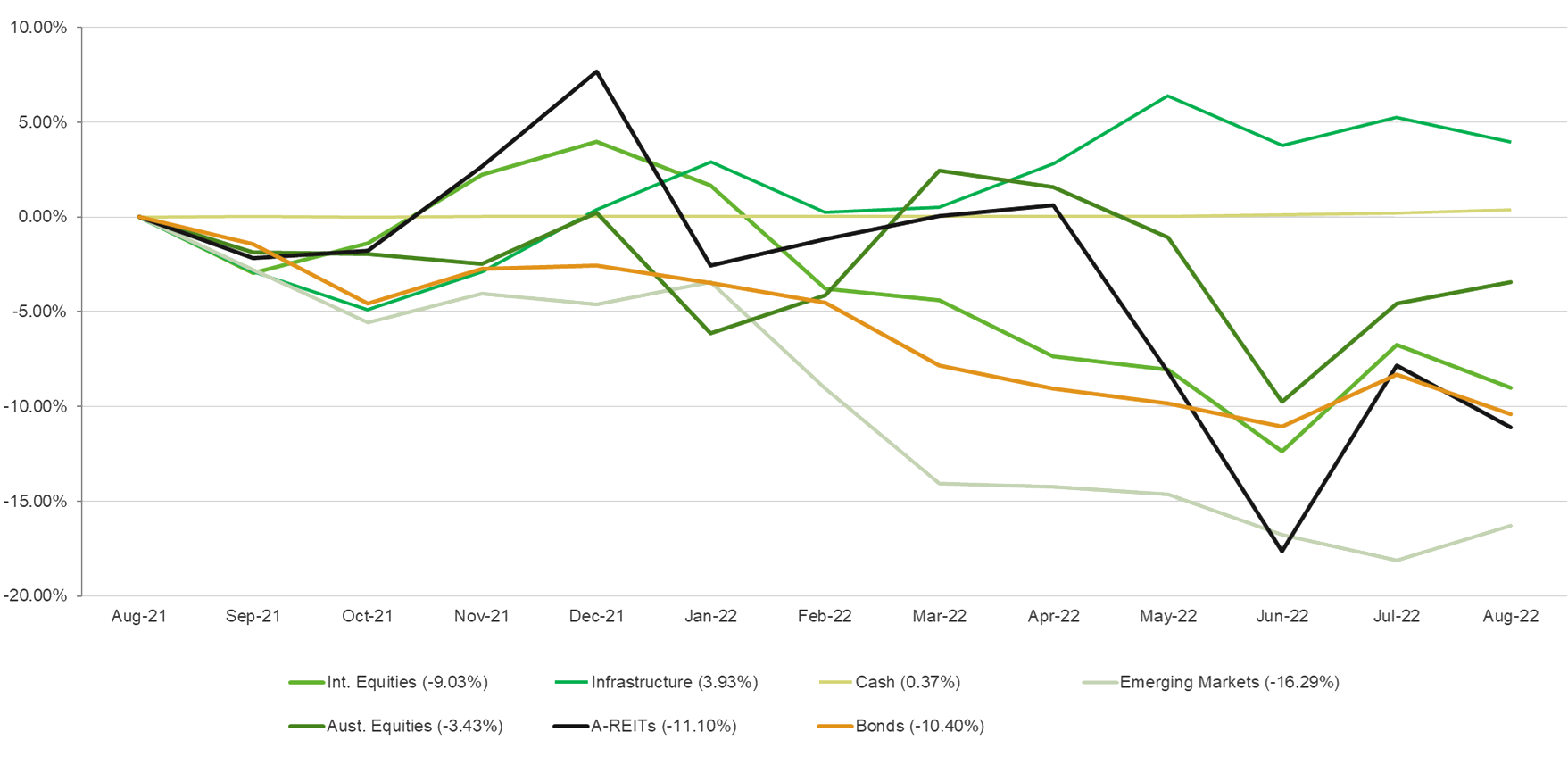
The above graph summarises the performance of the major financial markets and gives you an indication of how these markets performed over the last 12 months. The graph does not reflect your actual portfolio performance.
*Source Zenith Investment Partners