Market Summary | July 2021
MARKET OVERVIEW
Global Covid-19 cases continue to rise with numbers surpassing 197 million cases at the end of July, an increase of 14 million in the month. Delivery of vaccines continues to rise with 3.8 billion doses delivered globally as at the end of July, with the European Union saying that 200 million Europeans have been fully vaccinated. Vaccination remains key, as countries with high vaccination rates are showing lower hospitalisation and death rates even with increased infection rates.
Key economic indicators continue to improve generally, with several leading economies reporting above expected increases in inflation. Markets have also continued their positive momentum thus far in 2021.

The U.S. Senate closes in on the finalisation of a US$1 trillion infrastructure bill.
United States
The US Fed kept interest rates on hold at 0.25% as widely expected, indicating that it is moving closer towards tapering bond purchases. CPI rose 0.9% in June, surpassing expectations of 0.5% and marking it the largest monthly increase since June 2008.
US markets continued to rise over July, buoyed on by vaccine rollout which has helped deliver strong Q2 2021 US corporate earnings results. Of the 89% of S&P500 companies that have reported actual results for Q2 2021 to date, 87% have reported earnings results above analyst estimates. Going forward, developed markets remain supported by near term fiscal policy initiatives with the US Senate close to finalisation of a bi-partisan US$1 trillion infrastructure bill.
The S&P 500 Index (USD) returned 2.27%
The Dow Jones (USD) returned 1.25%
Asia
Losses in emerging markets were driven by a deep selloff in Chinese technology and education stocks towards the end of the month as Chinese regulatory officials confirmed a leaked policy document banning for-profit tutoring, an industry with an estimated value c.US$120 billion. This began a sell-off in Chinese education stocks which spread to the Chinese technology sector, shaving off a combined US$1.0 trillion in company value, with the MSCI China index posting its largest decline since March 2020.
Hong Kong was not immune to this mainland decline, with the broader Hang Seng index declining by 9.9% over the month. Heightened regulatory risks for the region are expected to remain in the medium term as the market struggles to price in this regulatory uncertainty which has always been a risk of Chinese equities.
The Hong Kong Hang Seng PR Index (HKD) returned -9.94%
The Nikkei 225 PR Index (JPY) returned -5.24%
The Shanghai Shenzhen 300 PR Index (RMB) returned -7.90%
Europe
Eurozone economic sentiment rose in July for the sixth month in a row to an all-time high of 119.0, ahead of the expected 118.7. The increase was supported by hopes of a strong economic recovery due to the reopening of economic activities. The ECB left its policy setting unchanged at its July meeting, as widely expected.
In the UK, CPI rose 0.5% in June, surpassing expectations of 0.2%, as the yearly rate increased 0.4% to 2.5% (2.2% expected), marking the highest inflation rate
since August 2008.
The UK’s FTSE 100 PR Index (GBP) returned -0.07%
The German Dax (EUR) returned 0.09%
Australia
The RBA left the cash rate unchanged at 0.1% during its August meeting, as widely expected, while maintaining the target of 0.1% for the April 2024 Australian Government bond.
The Australian share market reached all-time highs in July, with the S&P/ASX 200 gaining 1.1% for the month. The Materials sector was the clear standout, benefiting from solid gains in both industrial and precious metals, which saw the sector up 7.1% for the month. Industrials also performed strongly with a gain of 4.3%. Information Technology gave up some of the impressive performance seen in June, with the sector retracing 6.9%. Energy and Financials were also weaker in July, both falling 2.5% and 1.4% respectively.
Attention now turns to the reporting season which commenced late last month. Investors will be eagerly awaiting results to ascertain whether the impressive market rally from the COVID-induced lows of last year has been justified. Equally paramount will be any commentary offered by companies on their expectations for the future, given the dearth of outlook statements provided last year.
Rio Tinto reported earnings on 28 July 2021; one of the more highly anticipated reports given the impressive rise in iron ore prices over the past year. The miner didn’t disappoint, reporting record half-year earnings which more than doubled from last year. Rio reported underlying earnings of US$12.2bn compared with US$4.8bn a year earlier. The company will pay out an impressive US$9.1bn in dividends, consisting of a special dividend of US$1.85 per share and an interim dividend of US$3.76 per share.
Market Returns (last 12 Months)
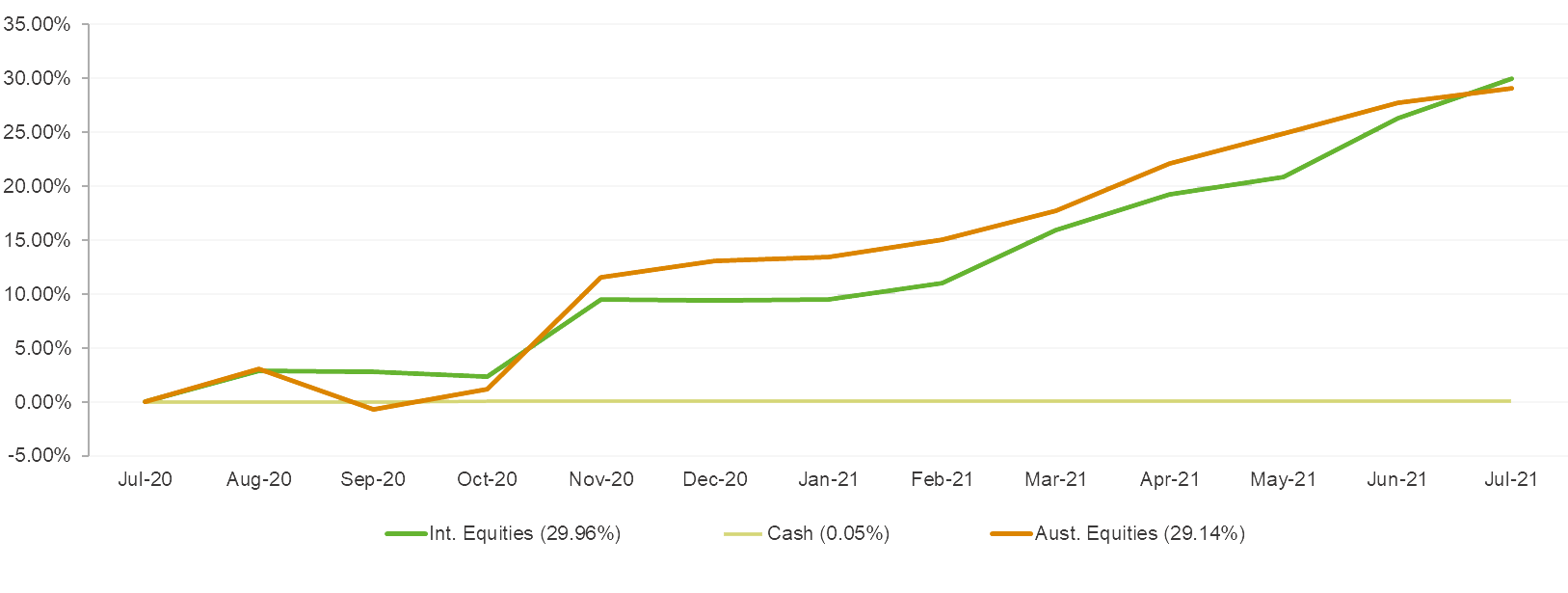
The above graph summarises the performance of the major financial markets and gives you an indication of how these markets performed over the last 12 months. The graph does not reflect your actual portfolio performance.
*Source: Lonsec Research Pty Ltd