
Market Summary | July 2018
MARKET OVERVIEW
July was a relatively strong month for markets with the exception of emerging market equities, which continued to show volatility. Despite this, returns for key asset classes were strong, with equities leading the way, posting strong returns for the month.
While volatility is expected to rise, key economic indicators such as the unemployment rate, Purchasing Manager Index (PMIs) and consumer confidence indicators across key economies remain conducive to growth in the near term. Interestingly the shape of the yield curve has flattened. Historically, inverted yield curves have been a precursor to recessions, which tend to follow six to twelve months after the yield curve has flipped. Asset class valuations remain fair to expensive, however the increased volatility in some sectors has created some early signs of valuation support.
UNITED STATES
The US added another 213,000 jobs in June as the economy’s long-running growth streak continued. Then came the news that the economy had grown at an annualised rate of 4.1% in the second quarter of the year, helped by strong consumer spending and a surge in exports. President Trump was quick to seize on the news as proof that his policies were working as the US economy recorded its fastest rate of growth since 2014.
But all the news continues to revolve around trade wars and about the President, who held a meeting with the President of the European Commission (Jean-Claude Juncker), which seemed to avert the threat of a US/Europe trade war. Wall Street shrugged off the worries, with the Dow Jones index rising 5% in the month of July.
ASIA
The Chinese market got off to a poor start, a fall of 2.5% in one day as the deadline for the first raft of Trump Tariffs arrived. However, the real damage was done in June, in the anticipation of the tariffs.
Later in the month, the Chinese government took steps to protect its economy against the possibility of a long trade war after a slight slowdown in 2nd quarter growth, introducing some tax cuts and taking steps to issue special bonds for local government infrastructure projects.
The economy had slowed slightly, meeting official expectations of 6.7% annualised growth, but falling slightly behind the 6.8% recorded in the first quarter. The Chinese market had recovered the lost ground by the end of the month, where it closed up 1%. The Japanese market was up by a similar amount to. In contrast, both the Hong Kong and South Korean markets fell by 1% in July.
EUROPE
The British economy was stimulated by an estimated £2.7b in July due to the Three Lions impressive world cup run. The largest beneficiaries were the consumer and manufacturing sectors. There are now only 8 months until the UK is scheduled to leave the EU however there is increasing confusion and uncertainty on how this will be executed. The UK markets were up approximately 1% in July, unfortunately the Pound fell a similar amount.
Brexit aside, July was an unusually quiet month in Europe. The European parliament rejected an overhaul of the copyright laws, which had sparked a fierce debate between the internet giants and content creators, the latter fearing increasing infringement of their copyright and exploitation of their content. Perhaps the European parliament decided that the introduction of GDPR was enough of an administrative burden for one year.
Europe’s two major stock markets moved in step during the month. Both the French and German markets rose by 4% during July.
AUSTRALIA
Given the risks within the household sector, the RBA was happy to sit on the bench, holding rates at 1.50% at its August meeting. While household debt and sluggish wage growth remain a concern, the business sector is enjoying favourable conditions, especially in the manufacturing, construction and business services industries.
Downside risks remain, with a tightening in lending conditions, partly in response to the Royal Commission into Financial Services, constraining households and the possibility of a sharp decline in house prices posing a challenge to the prudential system. House prices have been falling for the past nine months in Sydney and auction clearance rates remain in the low-60% range.
The ASX 200 was up 1.4% in July with the industrials (+3.5%) and telecommunications (+7.9%) sectors leading the way. The telecommunication sector was dominated by Telstra (+8.4%), which appeared to recover as attention turned to the much anticipated 5G spectrum auction, putting a halt to a seven-month slide. Another notable performer was Brambles (+11.3%) built on positive sentiment ahead of its full-year earnings release in August, despite its US operations continuing to drag.
MARKET RETURNS (LAST 12 MONTHS)
Markets have had a positive 12 months. Returns have been positive in all growth asset classes. Equity markets generally have performed well while fixed income and cash returns remain at historically low levels. The month of July provided positive returns across the asset classes with stronger performance coming from International & Australian Equities.
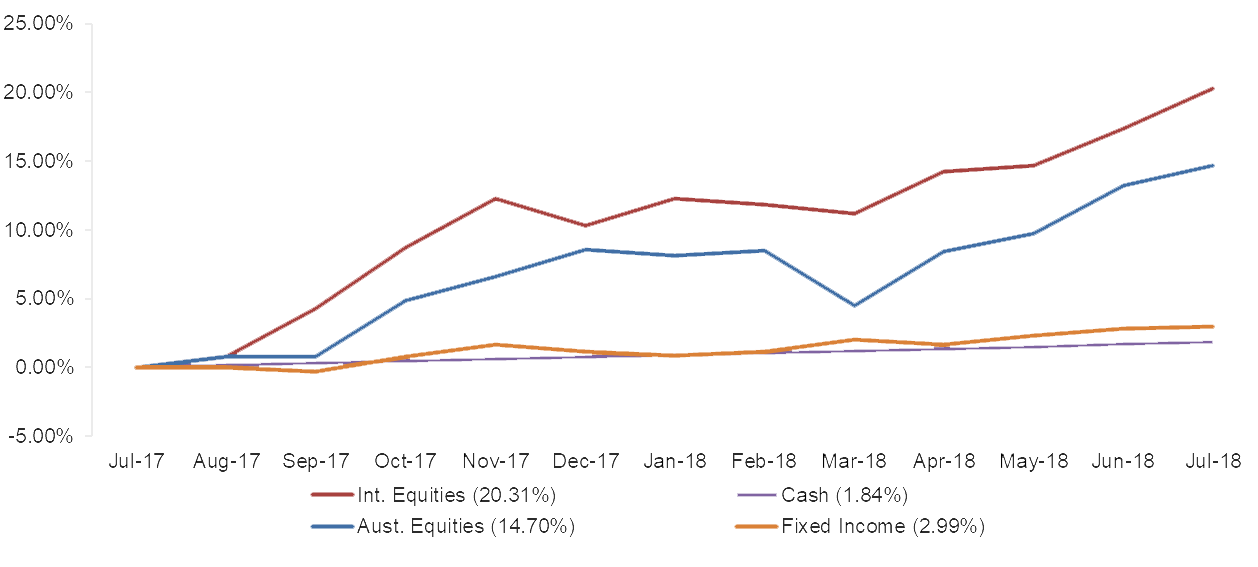
The above graph summarises the performance of the major financial markets and gives you an indication of how these markets performed over the last 12 months. The graph does not reflect your actual portfolio performance.