
Market Summary | July 2017
Overview
The beginning and end of the month saw Kim Jong-un get a little feisty with two ICBM’s (Intercontinental Ballistic Missile) being launched. The Washington Post described the first test as ‘a grave milestone’ and the regime in Pyongyang claimed the second test brought ‘the whole of the US within range.’ At the beginning of August, CNN was reporting ‘unprecedented levels’ of North Korean submarine activity: the situation is likely to get worse.
Lloyds of London warned that a global cyber-attack could cost the world economy $53bn, there were simmering tensions between China and India and the International Monetary Fund downgraded its growth forecasts for both the UK and the United States. Meanwhile, at the G20 summit in Hamburg President Trump fell out with all the other world leaders over climate change.
China
China’s authorities still face a difficult balancing act in maintaining 6.5% annual GDP growth while at the same time recalibrating key growth drivers and conducting necessary economic reforms. At this stage, the difficult economic policy balancing act is being achieved and China is unlikely to compromise global economic growth prospects in 2017 as many forecasters feared at the beginning of the year.
Clearly, plenty of lenders are confident that the Chinese economy will continue to grow as figures from the Bank for International Settlements showed a surge in lending to China and Chinese companies. International banks lent $92bn to China in the first quarter of the year, well up on the same period in the previous year.
Europe
Business organisations – speaking via the CBI (UK’s premier business organisation) – definitely want some sort of transition deal after Brexit, but credit rating agency, Moody, suggested that there was now a ‘substantial probability’ of no deal being reached. Given the fact that all 27 members of the European Union need to agree to the deal and there are just 19 months to go until March 2019 that view is looking increasingly credible. With Europe now largely on holiday for a month and then the German elections due in mid-September, it is easy to see it being October before any significant progress is made.
In a similar fashion to the UK, France’s Ecology Minister Nicolas Hulot announced a ban by 2040, on the sale of any car that uses petrol or diesel fuel. There is some way to go, however at the moment hybrid vehicles make up 3.5% of the French market, with pure electric vehicles accounting for just 1.2%. The announcement was part of a renewed commitment to the Paris climate deal, with Hulot saying that France planned to become carbon neutral by 2050. However, both the UK and France were beaten to the punch by Volvo, with the Swedish-based, Chinese-owned company announcing that all its new models will have an electric motor from 2019.
United States
The Trump Administration has become more dysfunctional, to the point where it cannot negotiate a path through Congress for key legislation. Plans to overhaul health care have failed and hope is fading rapidly for President Trump’s plans for budget spending and tax cuts.
There is now a strong likelihood that the Trump budget stimulus will not happen, but that the Fed will continue to slowly tighten monetary policy. As a result, the slow momentum in US economic growth looks set to carry through the rest of 2017 and into 2018.
Australia
Despite strong GDP growth, there are weak patches in the Australian economy. The prolonged downturn in mining investment may be all but over, but the downturn in residential construction is only just starting. The Australian economy is a mixed bag, but one that on balance appears to be taking an improving turn.
The RBA remains upbeat in its economic forecasts, detailed in its early-August Monetary Policy Statement continuing to provide an unheeded warning signal to the Australian market that its next move is likely to be a rate hike, albeit not until 2018.
Market Returns (last 12 months)
Markets have had a positive 12 months. Returns have been positive in all growth asset classes. Equity markets generally have performed well while fixed income and cash returns remain at historically low levels. The month of July provided a mixture of negative and flat returns across the asset classes.
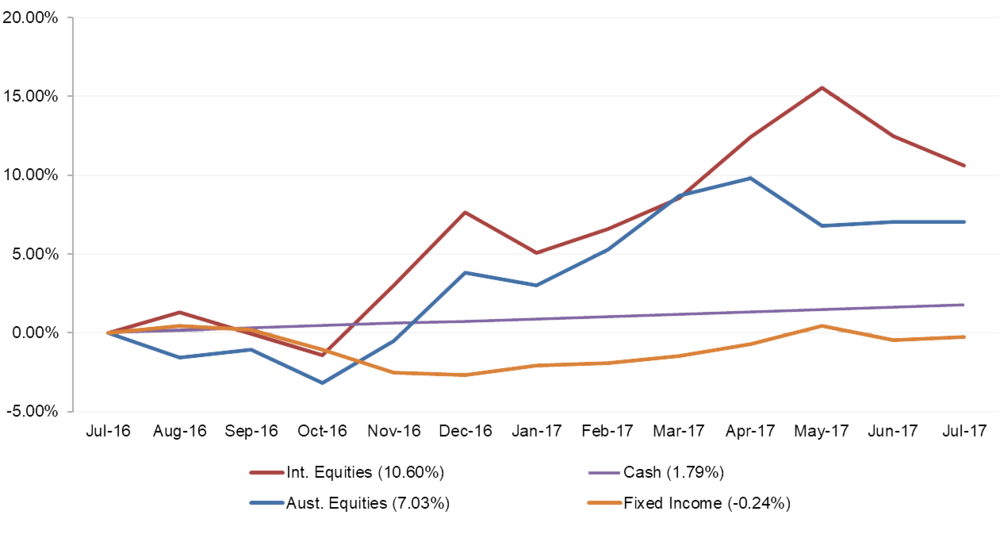
Note: The above graph summarises the performance of the major financial markets and gives you an indication of how these markets performed over the last 12 months. The graph does not reflect your actual portfolio performance.