
Downsizer Contributions
Since 1 July 2018, downsizer contributions have afforded eligible older Australians the opportunity to top up their retirement savings where their existing balance leaves them concerned about the sustainability of their lifestyle through retirement. It had been observed that older Australians were potentially being discouraged from downsizing hones that no longer met their needs, the result being that many larger family homes were being occupied by singles or couples.
CAPITAL PROCEEDS
The Income Tax Assessment Act requires that a downsizer contribution be “an amount equal to all or part of the capital proceeds received from the disposal of a current or former home. The capital proceeds of sale refers to “gross capital proceeds”, that is, the amount before deducting any selling costs, agent fees, and any paying down of a mortgage.
The maximum amount an individual can contribute will be less than $300,000 if a property is sold for less than that amount. So, if a property is sold for $295,000, this will be the maximum size of a downsizer contribution.
While an individual will be able to make a tax-free contribution of up to $300,000 into their superannuation account to boost their retirement savings, a couple can make two separate contributions into their respective superannuation funds of up to $600,000.
Example: Travis 65, is married to June, 63. Both Travis and June have separate superannuation accounts and recently sold their family home for $1.3 million. $600,000 of this amount can be used for downsizer contributions. Provided they make the contributions separately into their individual superannuation funds, Travis and June will each be able to contribute $300,000 into those funds as downsizer contributions (a total of $600,000).
CONTRIBUTIONS CAPS NOT APPLICABLE
Contributions caps that ordinarily apply to concessional and non-concessional contributions made to an individual’s superannuation in a financial year do not apply to downsizer contributions.
NO WORK TEST REQUIREMENT
There is no work test requirement associated with making a downsizer contribution. Usually, if an individual is over 67 years of age, they will be required to satisfy a work test requirement to make a personal contribution to superannuation.
TOTAL SUPERANNUATION BALANCE (TSB)
Individuals who have a total superannuation balance (TSB) of $1.7 million or more on 30 June of the previous financial year cannot make non-concessional contributions into their superannuation in the current financial year. However, an individual’s eligibility to make a downsizer contribution is not constrained by the TSB limit.
The downsizer contribution will be counted towards the individuals TSB at the end of the financial year in which it is made.
POTENTIAL IMPACT
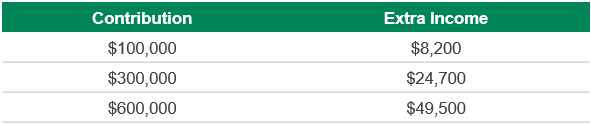
Based on earnings of 5.51% and tax-free income payments over 20 years, the following demonstrates how much of a difference downsizer contribution can potentially make to an individual’s or couple’s retirement income:
ELIGIBILITY TO MAKE DOWNSIZER CONTRIBUTIONS
What are the specific eligibility requirements for making a downsizer contribution to superannuation?
Age: An individual must be 60 or older when they make a downsizer contribution, and no maximum age limit applies.
Ownership period: An individual or their spouse must have owned the home for 10 years or more before selling their property (the ownership period is usually calculated from the date of settlement of purchase to the date of settlement of sale).
The home itself: Must be in Australia and not be a caravan, a houseboat or other mobile home. Additionally, the home must qualify under the capital gains tax (CGT) main residence exemption.
Tax exemption eligibility: The proceeds from the sale of the home must either be exempt or partially exempt from CGT under the main residence exemption or would be entitled to that exemption if the home was a CGT rather than a pre-CGT (acquired before 20 September 1985). In simple terms, you must be able to disregard at least part of or all of the CGT on the disposal.
Paperwork: An individual must have provided their superannuation fund with the “downsizer contribution into super form”, either before or at the same time as making the contribution.
Timing: The contribution must be made within 90 days of the change of ownership occurring (usually at the date of settlement).
No previous contribution: An individual must not have previously made a downsizer contribution to their superannuation using the proceeds of another home.
MULTIPLE CONTRIBUTIONS
A person eligible to make downsizer contributions may make multiple contributions from the proceeds of sale of a single property, provided that the total of all contributions made does not exceed $300,000 or the total proceeds of sale. Where multiple contributions are to be made, they must occur within the 90 day period.
EXTENSION OF TIME TO CONTRIBUTE
An individual may be able to obtain an extension of time to make a downsizer contribution beyond the usual 90 day period from the date of settlement. An individual should request an extension of time before that 90 day period has expired.
In circumstances in which the 90 day time-frame has been overlooked, a time extension still may be allowed for reasons that include: ill health, death in the family, moving house.
An extension of time will not be granted if the reason for applying is to allow the applicant to meet the age requirement (for example, if the individual will turn 60 just outside of the 90 day period).