
Market Summary | December 2021
MARKET OVERVIEW
Markets struggled to build momentum early in the month of December as the emerging and enigmatic Omicron variant of the COVID-19 virus continued its spread across the globe. As understanding about the new strain developed (particularly its highly infectious but less potent nature), investors were reassured that economic growth would not be stalled as governments widely exercised restraint with reinstituting lockdowns and restrictions abroad.
Global supply chains are still constrained – and likely to remain so for the next 18 months – as major shipping ports remain backlogged, with infrastructure unable to keep pace with contain vessels, due to a lack of land crews and truck drivers.
Despite this, global markets closed out 2021 strongly, posting an annual return of 29.6% in Australian dollar terms. Developed markets closed 1.7% higher by month end, trailed by Emerging and Asian markets declining by -0.7% and -1.1% respectively.

Australian retail sales lifted 7.3% in November, well above the expected 3.9%.
United States
The Federal Reserve kept its policy rate unchanged at 0.00-0.25%, as expected and announced at its December meeting it would end its pandemic-era bond purchases in March, paving the way for three interest rate hikes by the end of 2022.
CPI rose 0.5% in December, above expectations of 0.4% growth, while the yearly rate increased 20bps to 7.0%. The yearly core inflation rate lifted 60bps to 5.5%, coming in slightly above expectations of 5.4%. Consumer sentiment surprised in December, increasing 3.0pts to 70.4, compared to expectations of a decline to
67.1.
The S&P 500 Index (USD) returned 4.36%
The Dow Jones (USD) returned 5.55%
Asia
Notably, Emerging and Asian markets posted disappointing year end annual returns of 3.4% and 0.9% according to the MSCI Emerging Markets NR Index (AUD) and MSCI AC Far East NR Index (AUD) indices respectively. This is mainly attributable to the more difficult conditions that emerging economies have had to cope with in the face of a COVID-19 centric world.
The Bank of Japan left interest rates unchanged at -0.10% during its December meeting. Additionally, policymakers elected to reduce corporate debt buying to pre-pandemic levels, while extending emergency pandemic funding by six months until the end of September 2022, to support the financing of small and medium-sized firms.
The Hong Kong Hang Seng PR Index (HKD) returned -0.33%
The Nikkei 225 PR Index (JPY) returned 3.49%
The Shanghai Shenzhen 300 PR Index (RMB) returned 2.24%
Europe
The European Central Bank made no change to interest rates at its December meeting, holding them at 0.0%. However, it announced the reduction in the pace of its asset purchases under its €1.85 trillion PEPP next quarter with the scheme to be wound down in March 2022.
In the UK, The Bank of England unexpectedly increased interest rates from 0.10% to 0.25% at its December meeting, as inflation pressures continue to mount. CPI rose 0.7% in November, above the expected 0.4% taking the annual inflation rate from 4.2% to 5.1%.
The UK’s FTSE 100 PR Index (GBP) returned 4.61%
The German Dax (EUR) returned 5.20%
Australia
The RBA left the cash rate unchanged at 0.1%, as widely expected, and will continue its $4-billion-a-week bond buying stimulus program until at least mid-February.
Retail sales lifted 7.3% in November, well above the expected 3.9%, as consumers brought forward Christmas spending to take advantage of sales and minimise delivery and stock availability concerns. November’s unemployment rate fell to 4.6%, well below market estimates of 5.0%, with the participation rate increasing to 66.1%.
The Australian share market closed out December 2021 with the S&P/ASX 200 gaining 2.75% with eight out of the eleven sectors within the Index finishing higher. Specifically, Utilities was the standout sector with a return of 7.9%, whilst Materials (+6.5%) and Property (+4.9%) delivered strong returns. A heavy decline in the Information Technology sector (-5.3%) failed to stop the broader ‘Santa Rally’ to close out the year.
The local miners were bolstered by the iron ore price recovery given the optimism around Chinese demand for the commodity in the intermediate term, alongside the expectations for potential further stimulus measures within China’s economy. The Utilities sector pared back some heavy yearly losses and investors looked for some defensive exposure. The Information Technology sector suffered heavy declines as investors weighed up the potential central bank interest rates rises in the intermediate term.
The Australian dollar regained lost ground over the month of December closing 2.3% higher relative to the greenback and 1.5% in trade-weighted terms. Headwinds early in the month from the unravelling Omicron COVID-19 variant plummeted the AUD to its annual low of 0.69, the only time the pair had dipped below 0.70 in 2021. Toward the end of the month conditions seemed to stabilise into the festive period as the globe acquainted itself with this new, much more highly infectious but seemingly milder symptomatic variant.
Market Returns (last 12 Months)
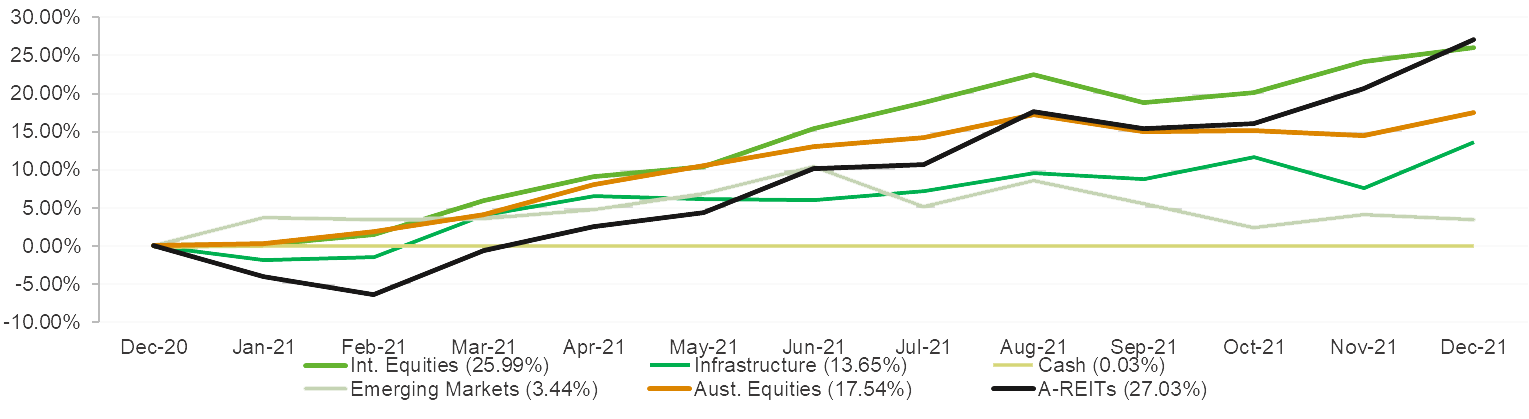
The above graph summarises the performance of the major financial markets and gives you an indication of how these markets performed over the last 12 months. The graph does not reflect your actual portfolio performance.
*Source: Lonsec Research Pty Ltd