
Market Summary | May 2023
Market Overview
Global equity markets were mixed in May with Japanese equities posting strong returns in local currency terms while European and UK markets gave up some recent gains. The S&P500 traded in a tight range with mega-cap stocks continuing to rally, offsetting weakness elsewhere. In the background, uncertainty over the US debt ceiling and ongoing concern over inflation saw markets push interest rates higher.

United States & Developed Markets
The MSCI World ex-Australia index declined by 0.9 per cent in May, cutting the year to date return to 8.8 per cent. A decline in the AUD meant the global market index in AUD terms rose 1.2 per cent. However, there was interesting divergence within the broader market indices. As alluded to earlier, some of the mega-cap names continued to rally in the US market and the Nasdaq was up 5.8 per cent. Indeed, the year to date return for the S&P500 is mostly accounted for by seven stocks including Nvidia up 174 per cent, Meta 118 per cent, Amazon 45 per cent, Alphabet 40 per cent, Microsoft 38 per cent and Apple 36 per cent. Investor focus on artificial intelligence has driven much of these returns while some investors also view such stocks as safe havens in the event of a recession.
The economic data continues to point to recessionary-type conditions within the global manufacturing sector while service sectors around the world remain solid, supported by strong labour markets, solid wages growth and excess savings. Given this backdrop, corporates have been able to pass on wages and other cost increases, keeping earnings elevated. While interest rate sensitive sectors were impacted by the rapid lift in rates in 2022 and early-2023, there are some signs of stabilisation, particularly in the US where builder sentiment has improved.
Of course, the US debt ceiling issue provided a source of uncertainty. The US reached its US$31.4 trillion debt limit in January and was forecast to “run out of cash” by early June. As has happened in previous stand-offs over the debt ceiling, the Democrats and Republicans ultimately agreed on a deal that would avoid a default. The debt limit was suspended until 2025, effectively increasing it, in return for a number of spending caps in discretionary areas. Importantly, spending caps do not apply to defence, social security and Medicare.
Japan continues to perform well with the Nikkei up a further 6.4 per cent in May to take the return this year to 18 per cent. In USD terms the MSCI Japan index was up a more muted 1.9 per cent in the month and 8.6 per cent for the year to date. Relatively cheap valuations, easy policy settings and improved corporate governance are cited as key drivers of this outperformance. Europe ex-UK was down 5.6 per cent although is up 9.6 per cent this year while the UK market dropped 6.6 per cent. Hong Kong, Portugal and Norway were amongst the poorer performers in the month, all down 8 per cent or more.
EMERGING MARKETS
The MSCI Emerging markets index declined 1.7 per cent in USD terms in May, taking the year to date gain to 1.1 per cent. In AUD terms emerging markets managed to lift 0.4 per cent and for the year so far, 5.8 per cent.
Weakness in Chinese equities continues to detract from EM performance. The Chinese economy has not rebounded as sharply as some had expected coming out of the 2022 lockdowns. The PMI for May fell to 48.5, a five-month low, while retail sales and industrial output were weaker than expected. While real estate prices and sales have recovered, investment in the sector remains weak. The authorities have avoided major stimulus, reflecting the government’s emphasis on consumption rather than real estate as the driver of growth going forward.
Emerging markets are being buffeted by high and rising global interest rates and a strong USD and investors are attaching a higher risk premium to Chinese equities given policy uncertainty. China’s growth, while disappointing expectations, is still well above the developed world while inflation is low and monetary policy is easy. Indian growth remains solid.
Australia
The Australian equity market underperformed global equities, declining 2.5 per cent in the month, reducing this year’s gain to 2.7 per cent, well short of global equities. As opposed to 2022, banks and materials have been a drag on performance due to rising recession risk and weaker commodities while a lack of IT exposure has also been a key factor behind the underperformance.
On a sector basis, materials were down 4.4 per cent and banks 4 per cent while consumer staples were also weaker. China’s post-Covid recovery has proved underwhelming and together with weaker global demand, commodity prices have declined 14% year to date with iron ore down 15 per cent. Banks have suffered this year from a combination of evidence of a peak in margins and concerns over credit conditions and quality globally. Only IT and capital goods managed to post positive returns.
The RBA surprisingly lifted the cash rate in early May to 3.85 per cent after having skipped the previous meeting. RBA governor Philip Lowe said the board had paused rate rises last month to assess the impact of previous rate rises on the economy, and strong jobs and inflation data meant it had more work to do to get price rises under control. "Inflation in Australia has passed its peak, but at 7 per cent is still too high and it will be some time yet before it is back in the target range," he noted in his postmeeting statement. "Given the importance of returning inflation to target within a reasonable timeframe, the board judged that a further increase in interest rates was warranted today." Australian bond yields rose to 3.61 per cent from 3.35 per cent, creating additional headwinds to equity valuations.
Inflation was higher than expected at 6.8 per cent, fueling the belief that the RBA may need to do more on rates. Interestingly, house prices have risen more than 4 per cent since the January low and while this may be supply-related, it surely will not please the RBA. The recent Fair Work Commission decision to grant a 5.75 per cent lift in award wages (impacting 20 per cent of the workforce), while keeping wages closer to inflation, will complicate the RBA’s efforts to bring inflation under control, particularly in the absence of a meaningful lift to productivity.
Asset Class Returns (last 12 Months)
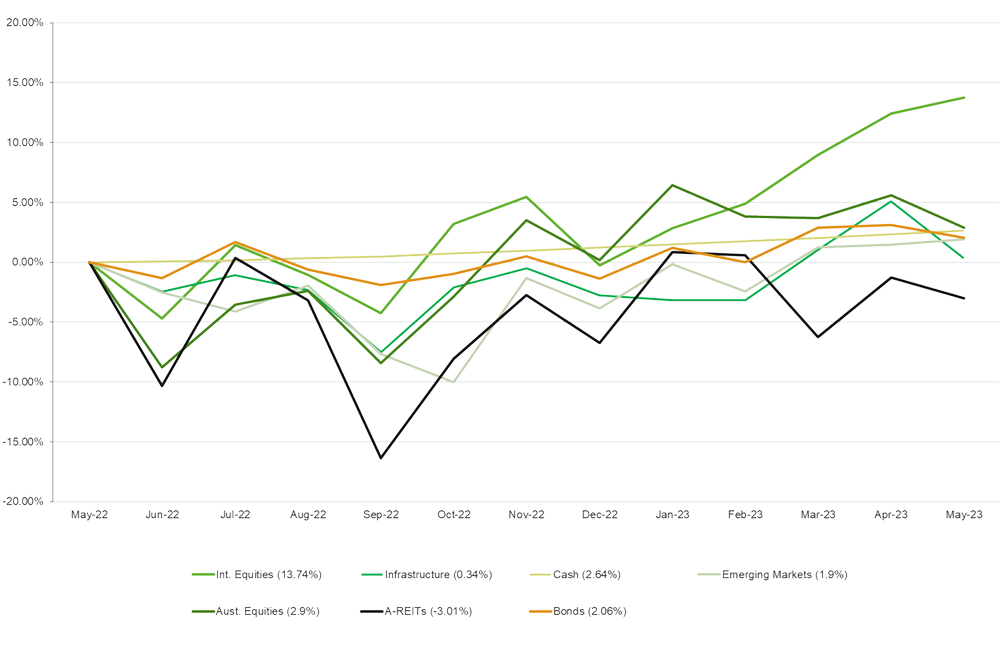
The above graph summarises the performance of the major financial markets and gives you an indication of how these markets performed over the last 12 months. The graph does not reflect your actual portfolio performance.
*Source Zenith Investment Partners