
Market Summary | February 2023
Global equity markets gave up ground in February as bond yields rose and markets reassessed the outlook for the Fed funds rate in light of strong payrolls and higher than expected inflation data. Australian Equities also fell as a strong start to the year lost steam.

UNITED STATES & DEVELOPED MARKETS
Global equity markets gave up ground in February as bond yields rose and markets reassessed the outlook for the Fed funds rate in light of strong payrolls and higher than expected inflation data. The MSCI World ex-Australia index declined 2.3 per cent in USD terms in February, taking the annual return to -7.5 per cent. Since September 2022 the index has risen 14.5 per cent with most of the recovery concentrated in October-November when inflation started to decline and the Fed signalled a step-down in its tightening cadence.
At the January 31-February 1 FOMC meeting, the Fed stepped down to 25 basis point hikes, as expected, raising the target range for the federal funds rate to 4.5-4.75 per cent. Markets initially focussed on the more dovish notes from the Fed chair, including the fact he could say "for the first time the disinflationary process has started".
The US market declined 2.4 per cent in February, a reasonable result considering the sell-off in bonds and the lift in rate hike expectations. In USD terms Hong Kong and Australia were two of the worst performers, down 7.1 per cent and 6.6 per cent, respectively, with currency a key driver. Europe ex-UK outperformed, declining 0.9 per cent, assisted by positive results in Spain and Denmark. The UK market managed a 0.25 per cent gain. For the year, Denmark and Spain were up 10.5 per cent and 9.3 per cent, respectively.
At the sector level, retailers, REITs, materials, energy and utilities were all down at least 4.5 per cent while flat performance from IT, despite rising bond yields, and only modest losses from industrials and banks cushioned the overall index performance. In terms of macro and factor exposures, EM exposure, cyclicals and growth outperformed while defensive, high dividend and momentum exposures underperformed.
EMERGING MARKETS
After rising 7.7 per cent in January, the MSCI Emerging markets index lost 6.5 per cent in USD terms in February, taking the annual loss to 15.3 per cent, well below global developed markets. In AUD terms, emerging markets dropped 2.3 per cent for the month to be down 8.8 per cent for the 12 months.
The weaker February performance was driven by two factors, the strengthening USD on the back of an upward reassessment of the Fed terminal rate and renewed concerns over China. After having rallied by more than 30 per cent from the October lows, the MSCI China equity index dropped 10.4 per cent in February. This was despite further evidence of a strong bounce in Chinese growth coming out of the Covid-lockdowns. The official manufacturing PMI rose to 52.6 from 50.1 while the service sector PMI jumped to 56.3 from 54.4 in January. The better economic news was offset by renewed geopolitical tensions between the US and China following the shooting down of a Chinese high-altitude balloon in US airspace.
MSCI EM Asia was down 6.9 per cent with Korea off 7 per cent, Taiwan 1.1 per cent while India was down 4.6 per cent. Emerging Europe managed positive returns in February, bolstered by strong returns in the Czech index (up 10.4 per cent) and Greece (9 per cent). Latin America was lower on a poor month from Brazil and a drop in Columbia amidst widespread protests against government reforms.
AUSTRALIA
The Australian equity market lost 2.45 per cent in January, taking the annual return to 7.2 per cent. Although underperforming in the month, domestic equities have provided significant outperformance over the past 12 months, assisted by the large weighting to banks and materials and the low weighting to IT.
During February the bank sector, which had performed extremely well on the back of rising interest rate margins, started to buckle under the pressure of prospects of higher cash rates. While banks generally benefit from a rising and higher interest rate environment, competition is beginning to impact margins according to the Commonwealth Bank (CBA) in its recent profit update. While home loan arrears are currently at record lows, the actual and prospective rise in mortgage rates is likely to begin to impact the household sector’s financial and balance sheet position going forward. Despite the CBA delivering a record $5.15 billion profit for the half-year, the bank sector declined 5.1 per cent in February to take the annual gain to 7.7 per cent.
The materials sector also gave up ground in February, declining 6.6 per cent, leaving the annual gain at 8.4 per cent. Despite reasonably positive news on growth out of China and Europe, commodity prices generally declined in February, partly reflecting the stronger USD.
The earnings season demonstrated the resilience of corporate Australia and the reasonably solid economic backdrop through much of 2022. As noted above, bank sector earnings were up more than 20 per cent while retailing was better than expected, reflecting solid consumer spending and higher margins. Both sectors are expected to find the next 12 months more challenging as interest rate hikes bite.
Finally, the interest rate backdrop continues to deteriorate. Over the month the market responded to the data in the US and RBA comments, lifting the cash rate projection by 50 basis points to 4.1 per cent year-end. Despite nine back-to-back hikes, the RBA has indicated that more rises are likely given higher than expected inflation. In a parliamentary hearing RBA governor Philip Lowe said "There is a risk that we've gone too far and don't need to do anymore, that the economy will slow more than we expect," . "But there's also a risk that we haven't done enough, that inflation proves more persistent and doesn't come down. And our job is to try and balance those.”.
ASSET CLASS RETURNS (LAST 12 MONTHS)
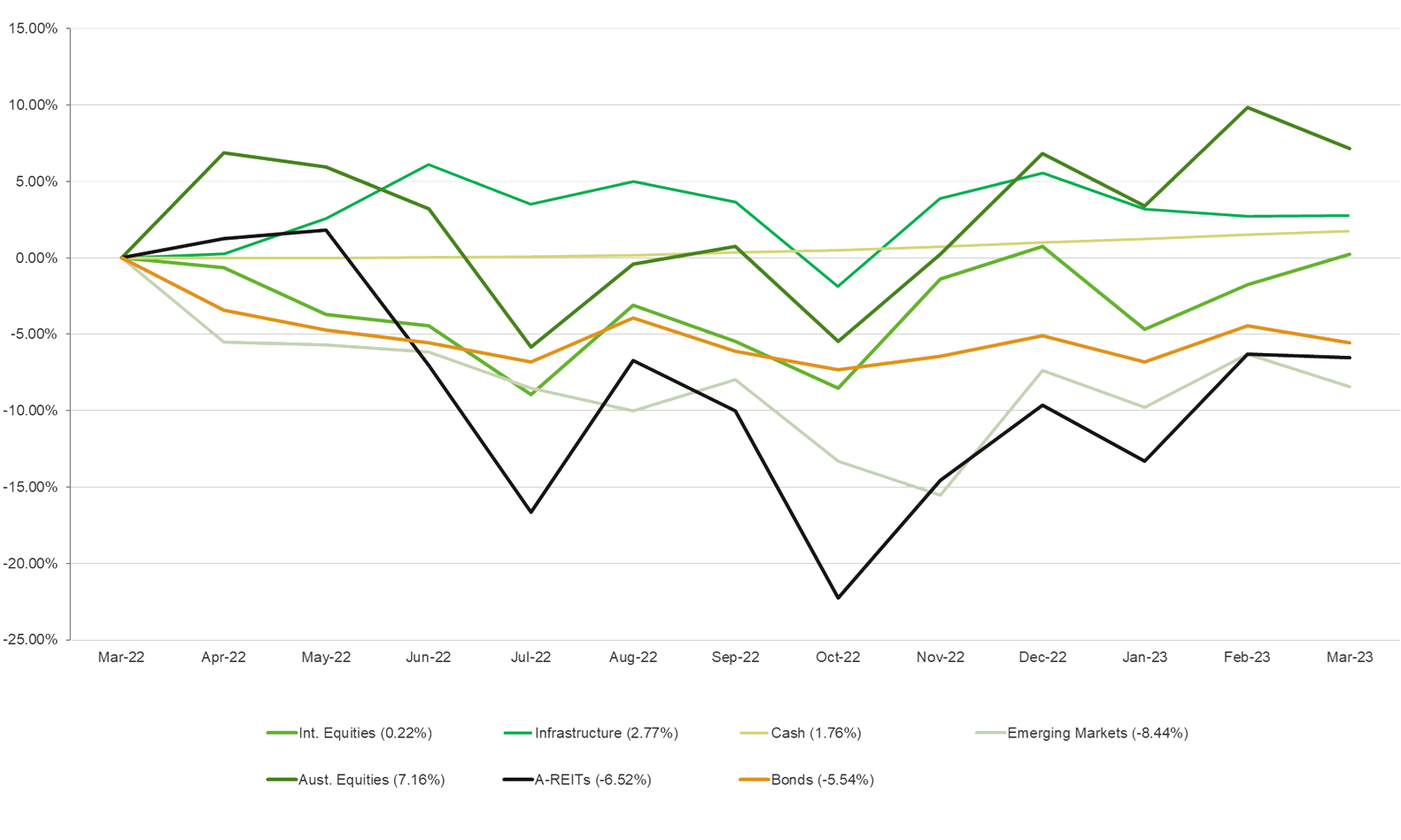
The above graph summarises the performance of the major financial markets and gives you an indication of how these markets performed over the last 12 months. The graph does not reflect your actual portfolio performance.
*Source Zenith Investment Partners