
Market Summary | September 2022
MARKET OVERVIEW
The sell-down in equities began in August and continued into September. Global equity markets sold off sharply in September as bond yields ratcheted higher and the global growth outlook deteriorated. A surge in real yields was the main culprit, undermining all asset valuations.
There were other factors undermining risk appetite during September. Russian President Vladmir Putin announced that Russia was “annexing” four regions in Ukraine while also raising the risks of an escalation in the war.
Towards the end of the month, the new leadership of the UK government announced a pro-growth fiscal policy, exacerbating the selloff in UK gilts and the pound to such an extent that it threatened parts of the UK pension system and ultimately prompted a (temporary) reversal of the Bank of England’s QT policy and some of the government’s fiscal easing measures.

UNITED STATES & DEVELOPED MARKETS
The US S&P500 dropped through the June lows (3666.77) by the end of September to 3585.6, with US equities ending down 9.3 per cent for the month and 4.8 per cent for the quarter. Europe ex-UK was down 8.7 per cent in September and 9.9 per cent in the quarter. Norway was the worst performer, down 19 per cent as oil prices tumbled almost 9 per cent on weaker demand. The Japanese market was 10.4 per cent lower while the UK market was down 8.8 per cent, a little surprising given the carnage in its bond and currency markets.
With the AUD falling against the rampant USD, the loss in global equities in AUD terms was contained to 3.2 per cent for the month and was up 0.4 per cent for the quarter. Nevertheless, for the year to date, Australian equities have outperformed global unhedged counterparts, down 9.6 per cent compared with -15.8 per cent.
In terms of economic data, the most interest rate sensitive sectors of the US economy continue to soften. With mortgage rates above 6 per cent and affordability low, existing home sales are down 25 per cent this year, new home sales are 34 per cent below late-2020 peaks, while starts have dropped 13 per cent. Despite some stabilisation in August-September, US consumer confidence is at recessionary levels. On the positive side, price pressures, as measured by ISM prices and supplier delivery times, are easing. Payrolls continue to beat expectations although there are signs that job openings are beginning to roll over as companies place a freeze on new hires. On the inflation front, the news was mixed with August headline inflation easing to 8.3 per cent (from 9.1 per cent in June) although core inflation was higher than expected and rose to 6.3 per cent. The Fed’s preferred inflation measure, the core PCE price index, was up 4.9 per cent.
Europe continues to deal with soaring energy costs, high inflation, and an expected recession. Nord Stream 1, the main pipeline supplying gas to Europe from Russia, was closed for maintenance in July. It came back onstream temporarily before Russia shut it down again in early September. The ECB lifted rates by 0.75 per cent to 1.25 per cent with ECB President Christine Lagarde, indicating such moves on this scale were not “the norm,” but there would be “several” rate rises in the coming months to bring inflation down.
At the sector level, REITs were the hardest hit, down 12.9 per cent in the month and 11.7 per cent for the quarter. Rising bond yields also had a large impact on the IT sector, down 11.9 per cent in the month although “only” 6.3 per cent for the quarter. Communications, utilities, and industrials were all down more than 10 per cent for September while for the quarter energy was the best performer, down just 1.4 per cent. For the year to date, energy is up 22.2 per cent.
EMERGING MARKETS
Emerging markets slumped 11.7 per cent in September in USD terms, taking the quarter’s loss to 11.6 per cent and the year-to date return to -27.2 per cent. Emerging markets in USD terms have declined for five consecutive quarters. In AUD terms, emerging markets declined 5.9 per cent in the month, 5.4 per cent for the quarter and 17.6 per cent for the year to date, underperforming both Australian and global unhedged equities.
Emerging markets face numerous headwinds at present. The strong USD is imposing a tightening of policy in many emerging economies while they deal with slowing economies. China is the exception, as it has been easing policy in response to an economy beset by a property sector slowdown and Covid lockdowns. Chinese inflation has remained low, allowing the authorities to take an easier policy stance than most other countries however, the Chinese currency is now being impacted by rising US rates. In USD terms the MSCI China index was down 14.6 per cent in the month and 22.5 per cent for the quarter. The China A 50 index fared better, down 8.8 per cent in September for a 19.8 per cent loss in the quarter.
India has proven to be one of the better performing emerging markets, up 6.5 per cent for the quarter but down 9.7 per cent year to date. The economy has been resilient, with the latest PMI reading at 55.1, well above most other economies. Meanwhile, EM Latin America dropped 3.3 per cent in the month but was up 3.6 per cent for the quarter. Brazil rose 8.5 per cent for the quarter and is up 11.5 per cent this year, supported by its exposure to commodities and some favourable political developments. Turkey was the best performing market, overcoming an inflation rate of 80 per cent, assisted by a solid economy and interest rate cuts.
AUSTRALIA
The Australian equity market declined by 6.2 per cent in September although for the quarter managed to rise 0.4 per cent, in line with global equities in unhedged terms but well ahead of the 5.2 per cent drop in hedged global equities in the quarter. The ASX200 ended the quarter at 6474, slightly above the low of 6433 reached in June. The Small cap index fell 11.2 per cent in September for a -0.5 per cent result for the quarter.
The RBA lifted the official cash rate by a further 0.5 per cent in September to 2.35 per cent, the fourth consecutive 50 basis point hike. With rates at the lower end of what is considered neutral the RBA is expected to hike rates further over the coming months and quarters in order to bring inflation under control. There is, however, debate over the pace and magnitude of rate rises going forward.
Notwithstanding one of the sharpest tightening cycles experienced and acknowledging that investors have lost considerable wealth, the Australian equity market has fared relatively well in 2022, down 9.6 per cent while unhedged global equities have dropped 15.8 per cent and several major markets have fallen well in excess of 20 per cent. The superior relative performance can be attributed to a less aggressive central bank in the face of lower inflation and wages pressure, a market structure that is less sensitive to rising bond yields and a stronger banking sector. Australian banks have declined just 5.4 per cent in 2022 compared with 23.4 per cent for global counterparts. The materials sector, a heavy weighting in Australia, has declined by just 2 per cent in 2022 compared with 23.9 per cent globally while global IT has declined 34.1 per cent this year, a sector with a lower weighting in Australia.
ASSET CLASS RETURNS (LAST 12 MONTHS)
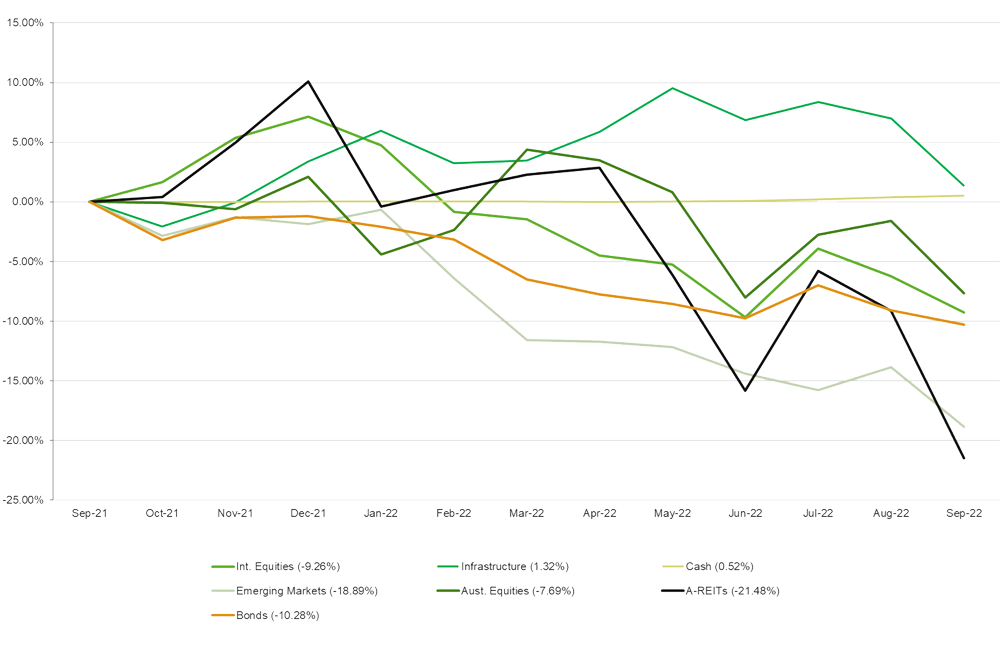
The above graph summarises the performance of the major financial markets and gives you an indication of how these markets performed over the last 12 months. The graph does not reflect your actual portfolio performance.
*Source Zenith Investment Partners