
Market Summary | July 2024

In July, the Australian equity market outpaced global equities, driven primarily by a strong performance in the banking sector. Positive inflation data and a potential easing of interest rates by the Reserve Bank of Australia (RBA) further bolstered the market, although global uncertainties, including tightening in Japan and weak Chinese growth, dampen the broader outlook. In contrast, global markets experienced volatility, with US equities facing pressures from political events and disappointing earnings in mega-cap stocks, leading to a rotation into small-cap equities. Meanwhile, emerging markets underperformed, weighed down by weak performances in China and Taiwan, though India was a notable bright spot.
Australia
The Australian equity market outperformed global equities in July, rising 4.2 per cent to take the year to date gain to 8.6 per cent. Banks led the charge, rising a further 7.1 per cent after rallying 5 per cent in the previous month. Valuations for the bank sector sit close to record levels in absolute terms and at extreme levels relative to the broader market.
The market was supported by some good inflation data at month-end. With the April and May inflation data surprising to the upside, markets had started to price in the potential of a rate hike in Australia. However, headline inflation for the June quarter came in at 1 per cent and was lower than expected while the core measure rose 0.8 per cent to cut the annual rate to 3.9 per cent. While still a long way above the target, inflation is at least heading in the right direction and with the economic growth subdued, the RBA may well be able to ease policy settings before the end of the year.
Indeed, market projections for the cash rate at year-end have moved from 4.5 per cent to 4.15 per cent, helping bond yields decline and supporting equities during the month
However, as touched on earlier, policy tightening in Japan and the rapid rise in the yen, together with ongoing weakness in China is clouding the picture. Although the RBA no longer seems an impediment to the domestic equity outlook, the global growth backdrop is looking less secure. Earnings growth expectations for the Australian market remain subdued at less than 5 per cent, well below other key markets and with dividends below 4 per cent the Australian market remains challenged.
United States & Developed Markets
Global equity markets rose 1.8 per cent in July, taking the year to date return to 13.9 per cent in USD terms. In AUD terms for the year to date the MSCI World ex-Australia index is up 17.4 per cent. The S&P500 hit another record at 5663 on July 10 before ending the month at 5522.3. While the Fed indicated that it was more comfortable with the inflation outlook, allowing investors to more confidently price in a cut in Fed funds in September, markets were buffeted by a series of events over the course of the month.
A poor debate performance from President Biden and the attempted assassination of presidential candidate Donald Trump emboldened investors to price in a Trump election victory with equities rallying while US 10 year bond yields struggled to push below the 4.2 per cent level. The Microsoft outage, the UK election result and the shock French election outcome added to the volatility over the month. The withdrawal of President Joe Biden from the presidential race and the subsequent endorsement of his Vice President, Kamala Harris, reinvigorated the Democrat cause and has prompted markets to unwind some of the so-called “Trump trades”. But the major story was the decline in inflation, for the third successive month, and the prospect of the US Fed following on the heels of the ECB and BoE in cutting rates.
As July progressed the US mega-cap and AI-related stocks started to falter, partly on comments from Trump in relation to Taiwan but also on the back of earnings results disappointing lofty market expectations. A rotation into small-cap stocks, which had become cheap in relative terms given their exposure to higher borrowing costs and less certain earnings, began as markets started to price in a decline in interest rates.
For the month the communications sector was down 3.1 per cent and IT was down 2.1 per cent. The mega-cap stocks suffered their first meaningful decline for some time with Nvidia, Microsoft, Meta and Alphabet all down more than 5 per cent. Meanwhile, the US Russell 2000 index of small-cap stocks surged 10.1 per cent.
While Growth, Momentum and Quality factor returns were negative in July, the Value factor rose 4.8 per cent, its best relative performance since April 2022. At a country level Japan, Ireland and the UK were amongst the better performers while the Scandinavian markets lagged. On a sector basis, the more defensive REITs, Healthcare and consumer staples performed well, as did the more cyclical bank and industrial sectors.
One of the key developments was the BOJ’s surprise 15 basis point hike on the last day of July. It announced that it would lift its benchmark interest rate to 0.25 per cent and outlined plans to halve its monthly bond purchases by 2026 in a decisive move to tighten monetary policy in response to higher inflation and the extremely weak currency. The Japanese yen, which had weakened to 162 to the USD during the month, surged to end the month below 150. After month-end, the result has been a sizeable unwinding of the yen “carry trade” and a collapse in Japanese equities which has reverberated across other financial markets.
Emerging Markets
Emerging markets rose 1.8 per cent in AUD terms during the month, lifting the year to date return to 7.8 per cent, continuing the run of underperformance of global and domestic equities. EM Asia was down slightly while Latin America rose 1 per cent. Within the index India was one of the standouts, rising 4 per cent for a year to date advance of 21.5 per cent. With the global tech sector and AI-related stocks under pressure, Taiwan lost 4.3 per cent during July, paring the year to date return to 23.9 per cent.
Chinese stocks were down for the month, continuing the relatively poor performance this year. Some disappointing manufacturing and retail spending data, together with ongoing weakness in the property sector undermined the market. A 10 basis point cut in the benchmark cash rate failed to provide any meaningful support while the mid-July Third Plenary Session of the 20th Central Committee of the CCP was met with disappointment among observers, due to its perceived lack of immediate and concrete economic reforms.
Emerging markets remain relatively cheap to developed markets and the USD appears to have lost upward momentum, providing a more positive backdrop for the sub asset class. However, until such time as the Chinese economy stabilises and the global trade cycle begins to lift, emerging market equity performance is likely to be constrained.
Asset Class Returns (last 12 Months)
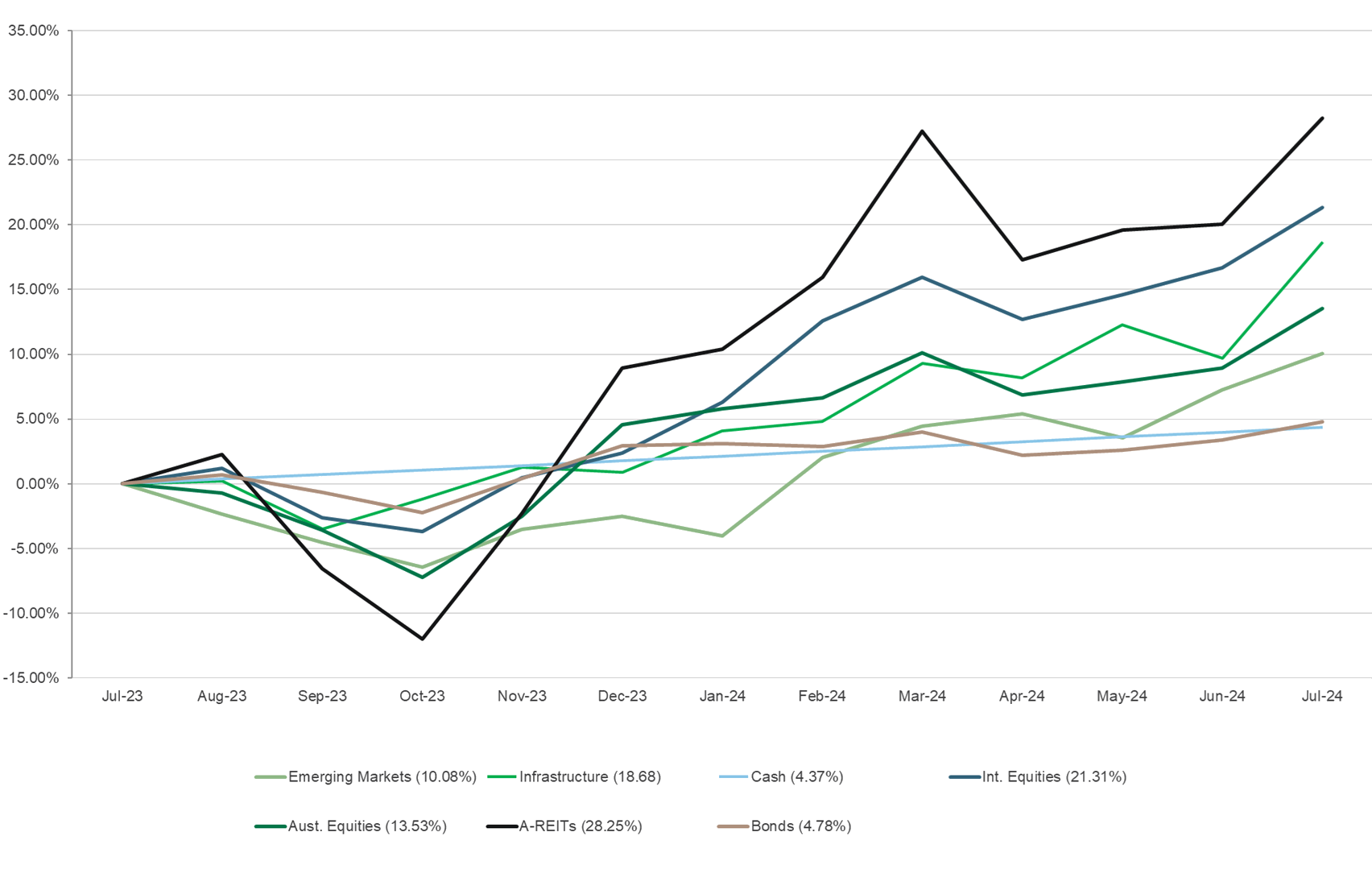
The above graph summarises the performance of the major financial markets and gives you an indication of how these markets performed over the last 12 months. The graph does not reflect your actual portfolio performance.
*Source Zenith Investment Partners